



Infrastructure optimized for growth

35+
Networks Supported

25ms
Avg Processing Time

25,000+ rq/s
Enterprise-ready

100+ TB
of Big Data

 Sign in

Access to full transaction data on all transactions & addresses

Retrieve blockchain data, balances, and transactions

Detailed blockchain history and transaction data for any address.

Full smart contracts metadata, including token symbols & token names

Access to full transaction data on all transactions & addresses

Get live crypto prices, exchange rates, supply and token contracts across protocols via one REST API.

Real-time notifications for events on top blockchains. Response under 100ms.

AML address screening across 35+ networks

Sync and manage HD wallets, keys and addresses

Local signing for EVM, UTXO, Tron, XRP, Kaspa and Solana

Precise blockchain transaction fee estimates based on transaction priority

Broadcast and verify transactions with real-time monitoring

Prepare EVM transactions, including token transfers

Test EVM transactions, optimize gas fees and identify security flaws

Pay for HTTP APIs, or charge for your own, in USDC stablecoin over the open x402 protocol — non-custodial, on-chain settlement.

MCP servers, CLI and skills for AI agents

Dedicated nodes infrastructure for leading blockchains using JSON-RPC

Address validation, encoding & cryptographic tasks optimizations

Shared node infrastructure for top blockchains using JSON-RPC.

Apr 9, 2026 • 4 min

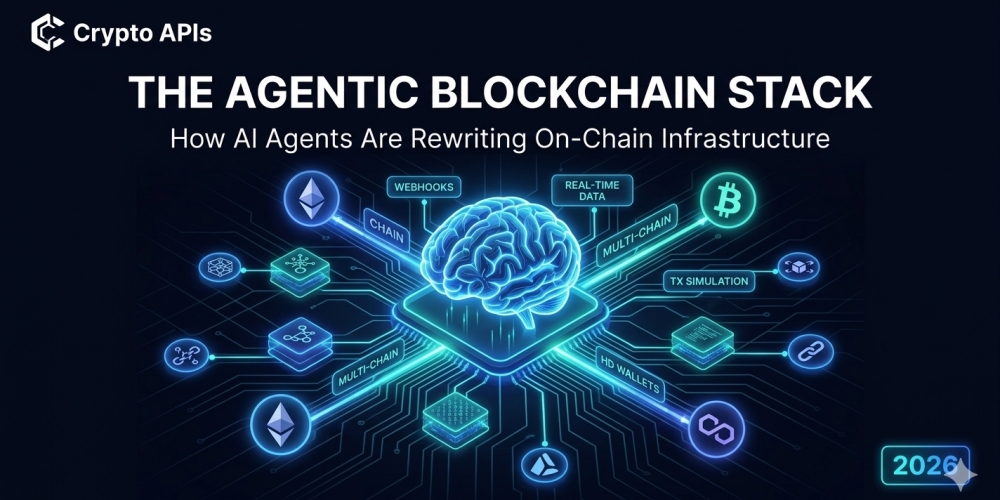
AI agents are no longer a future concept — they are actively managing wallets, executing DeFi strategies, monitoring smart contracts, and automating cross-chain operations right now. As we move deeper into 2026, one truth is becoming undeniable: the infrastructure powering these agents determines whether they win or fail.
Traditional blockchain applications were built for humans — dashboards, wallets, explorers. AI agents operate differently. They need millisecond-level data, deterministic API behavior, multi-chain coverage, and webhook-driven event pipelines that never sleep. The stack that powers a human's trading app cannot reliably power an autonomous agent operating 24/7 across 15 blockchains.
This is why the agentic era isn't just a trend for AI teams — it's the most important infrastructure moment the blockchain industry has seen since the rise of DeFi. And it demands a fundamentally different approach to how developers access on-chain data.
AI agents monitoring wallets — whether for compliance, portfolio management, or copy trading — need live data with the lowest possible confirmation lag. Crypto APIs' Address Latest product delivers real-time address activity updated with 1-block confirmation, covering balances, transactions, and token holdings across Ethereum, Bitcoin, Polygon, and 10+ other chains. Agents don't poll — they react. And they can only react as fast as their data layer allows.
Compliance bots, tax agents, and forensic analysis systems need to trace wallet behavior back to the very first transaction — not just the last 14 days. The Address History endpoint gives agents access to full historical data from the genesis block, including token transfers (NFTs and ERC-20), smart contract interactions, and complete transaction trails. This is the data layer that makes AI-driven audits and regulatory reporting actually viable at scale.
One of the most powerful capabilities emerging in agentic DeFi is pre-execution simulation. Before an AI agent commits capital on-chain, it should simulate the transaction. Crypto APIs' Blockchain Transaction Simulator lets agents test EVM transactions on Ethereum, Polygon, and BNB Chain in a risk-free environment — predicting outcomes, optimizing gas costs, and testing bundled transaction sequences. This is the difference between a smart agent and a reckless one.
Autonomous agents cannot rely on polling loops. They need event-driven architectures where on-chain activity triggers immediate action. Crypto APIs' Blockchain Events system delivers webhook alerts in under 100 milliseconds — for new blocks, mined transactions, unconfirmed transactions, and custom confirmation thresholds — all without agents needing to run or maintain their own nodes. This is the nervous system of any agentic blockchain application.
Agentic systems managing crypto portfolios or operating custodial services need to track hierarchical deterministic wallets programmatically across multiple chains. The HD Wallets Management product enables agents to sync addresses, balances, and transaction histories across 35+ networks — giving autonomous systems the financial visibility they need to make intelligent decisions without human intervention.
Here's what separates teams that successfully launch agentic blockchain products from those that stall in development: data reliability at scale. An AI agent might be executing 500 strategy evaluations per minute. Each one might require balance lookups, transaction history checks, gas estimation, and contract metadata reads. That's not a use case you can build on fragile infrastructure.
Crypto APIs was purpose-built for exactly this kind of load. With response times as low as 25 milliseconds for contract data retrieval, support for 35+ networks networks, and a complete suite covering everything from blockchain fees and gas optimization to real-time market data and broadcast transaction management, the platform gives agentic developers a single, unified API surface instead of stitching together five different providers.
The agentic blockchain use cases gaining the most traction in 2026 include autonomous DeFi portfolio managers that rebalance based on on-chain signals, compliance agents that monitor wallets for sanctions screening and transaction risk scoring, on-chain analytics bots that surface alpha from transaction patterns before they hit the mainstream, smart contract monitoring systems that detect anomalies and trigger automated responses, and cross-chain arbitrage agents that need sub-second data across multiple networks simultaneously.
Every one of these use cases depends on the same core infrastructure: reliable multi-chain data access, real-time event streaming, transaction simulation, and wallet management — all available through a unified API without the overhead of self-hosted nodes.
Building agentic blockchain systems is hard enough without fighting your data provider. Crypto APIs invests heavily in developer experience — structured API responses, comprehensive documentation, SDKs, and an architecture that scales from a weekend prototype to a production system processing millions of calls per day. The developer overview documentation is the starting point for understanding how the full product suite fits together for your specific use case.
The teams that define the agentic blockchain category are being built today. The infrastructure choices made in the next 12 months will determine which platforms scale and which ones get replaced. Choosing a data layer that was designed for the demands of autonomous agents — not retrofitted from a legacy explorer API — is one of the most consequential technical decisions a blockchain team will make in 2026.
Crypto APIs is built for what's next. Explore the full API suite and start building the agentic infrastructure your use case actually needs.
Networks Supported
Avg Processing Time
Enterprise-ready
of Big Data



 Copy link