



Infrastructure optimized for growth

35+
Networks Supported

25ms
Avg Processing Time

25,000+ rq/s
Enterprise-ready

100+ TB
of Big Data

 Sign in

Access to full transaction data on all transactions & addresses

Retrieve blockchain data, balances, and transactions

Detailed blockchain history and transaction data for any address.

Full smart contracts metadata, including token symbols & token names

Access to full transaction data on all transactions & addresses

Get live crypto prices, exchange rates, supply and token contracts across protocols via one REST API.

Real-time notifications for events on top blockchains. Response under 100ms.

AML address screening across 20+ blockchains

Sync and manage HD wallets, keys and addresses

Local signing for EVM, UTXO, Tron, XRP, Kaspa and Solana

Precise blockchain transaction fee estimates based on transaction priority

Broadcast and verify transactions with real-time monitoring

Prepare EVM transactions, including token transfers

Test EVM transactions, optimize gas fees and identify security flaws

Pay for HTTP APIs, or charge for your own, in USDC stablecoin over the open x402 protocol — non-custodial, on-chain settlement.

MCP servers, CLI and skills for AI agents

Dedicated nodes infrastructure for leading blockchains using JSON-RPC

Address validation, encoding & cryptographic tasks optimizations

Shared node infrastructure for top blockchains using JSON-RPC.

May 13, 2026 • 6 min

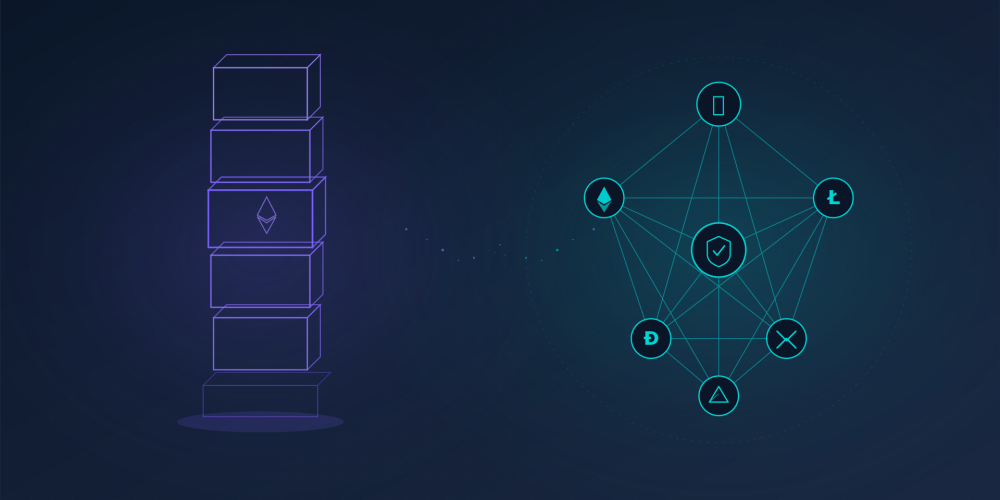
If you're choosing a blockchain infrastructure provider in 2026, "Alchemy alternative" is one of the most-searched queries in Web3 procurement — and for good reason. Alchemy has built one of the strongest EVM developer platforms on the market. But "best EVM platform" and "best blockchain API for a regulated business" are not the same question.
Crypto APIs is trusted by companies like PayPal, Fidelity, Nexo, Ledger, Tangem, and CoolWallet — crypto exchanges, payment processors, custodians, hardware wallet vendors, and tax & compliance platforms. Their needs are different from a typical dApp team. They settle in Bitcoin, Litecoin and Dogecoin as much as in Ethereum. They need OFAC screening before they credit a deposit. They need to issue thousands of unique deposit addresses under a single wallet, and know the second any of them gets funded.
This post is a straight, factual comparison — what Alchemy does well, what Crypto APIs does well, and how to pick the right tool for the job.
Alchemy is an excellent EVM-first developer platform. If your product is a dApp, an L2-native protocol, or a smart-contract wallet, Alchemy is built for you. Crypto APIs is a multi-chain infrastructure suite built around the needs of regulated crypto businesses — exchanges, PSPs, custodians, and tax/compliance platforms — with first-class UTXO coverage (BTC, LTC, DOGE, BCH, DASH, ZEC), AML address screening, full historical blockchain data from the genesis block, and real-time multi-chain webhooks. Different fits for different use cases.
| Capability | Alchemy | Crypto APIs |
|---|---|---|
| EVM RPC depth & ecosystem maturity | ★ Industry leader | Strong, unified across chains |
| EVM L2 coverage (Arbitrum, Optimism, Base, Polygon PoS, Starknet, ZKsync, Blast) | ★ Extensive | Yes, on supported networks |
| Bitcoin support | JSON-RPC node only (source) | Full data layer: address history, balances, UTXO, fees, events |
| Litecoin, Dogecoin, Bitcoin Cash, Dash, Zcash | Not listed in chain overview | Native, unified REST APIs |
| XRP Ledger, Tezos, TRON, Kaspa, Zilliqa | Not listed | Supported |
| AML address screening (OFAC SDN, sanctions programs) | Not offered in public docs | Verify Address endpoint — isFlagged, severity, sanction programs |
| HD wallet / xPub sync (derive & monitor thousands of addresses) | Not offered | Yes — HD Wallets Management |
| Historical blockchain data from the genesis block (full indexing) | Limited to recent blocks on most chains | Yes — every block, every chain |
| Webhooks / blockchain events | ★ Mature | <100ms unified events across chains |
| NFT API, Token API, Transfers API on EVMs | ★ Mature | Available via unified data endpoints |
| Smart-contract wallets (ERC-4337/7702), bundler, paymaster | ★ Yes (pricing page) | Not a focus |
| Pricing model | Compute Units, $0.45 → $0.40 per 1M CU (source) | Subscription plans + Pay As You Go, transparent per-call pricing |
| Free tier | 30M CU/mo, 500 CUPS (Compute Units Per Second) (source) | Free tier available — register |
Alchemy has spent years optimizing one thing very well: the EVM developer experience. If you're building a Uniswap-style DEX, an NFT marketplace, a smart-contract wallet using ERC-4337, or anything that lives inside the Ethereum L2 ecosystem, Alchemy's Node API, Bundler API, Gas Manager, NFT API and Transfers API are deeply integrated and well documented. Per their own pricing page, enterprise customers get signed SLAs, RBAC, SSO, increased eth_getLogs() ranges, and named solutions engineering — all things we'd recommend if your roadmap is fundamentally EVM-native.
That said — here are the cases Alchemy was not built for.
Alchemy does expose a Bitcoin RPC endpoint, and that's useful if all you need is getblockcount or sendrawtransaction. But a regulated exchange or a PSP doesn't query Bitcoin one block at a time. They need:
We built that layer because the hardware wallet, exchange and custody businesses we're trusted by have to support these chains on day one — and a raw node isn't a product.
If you're an exchange or a payment processor, you cannot credit a deposit from an OFAC-sanctioned address. Period. Our Verify Address endpoint returns:
Alchemy does not publish an equivalent endpoint in their documentation. For a compliance team, that means bolting on a separate vendor (Chainalysis, TRM, Elliptic) just to ship a deposit flow. With Crypto APIs, the screening call sits next to the balance call.
Most blockchain APIs let you query the latest blocks, recent transactions, and a rolling window of address activity. That's enough for a dApp. It's not enough for a regulated exchange that needs to audit a deposit address back to its first-ever transaction, a tax platform that has to reconstruct a customer's three-year on-chain history, or a forensics tool tracing illicit funds across years of activity. Crypto APIs indexes the full history of every chain we support — from the genesis block forward — and exposes it through the same REST endpoints you use for live data. No separate archive node, no separate vendor, no rolling window. Just one consistent API surface across the latest block and the oldest one.
Generate, organize and operate hierarchical deterministic (HD) wallets through a single API. Issue a unique deposit address per customer, monitor balances across the entire wallet, and pull transaction history for any derived address — without running your own indexer per chain. This is the difference between handing your engineering team a Bitcoin RPC node and handing them a managed deposit-address system. Not something you'll find in Alchemy's product list.
Alchemy's developer experience is built on JSON-RPC — perfect if you're already thinking in eth_call and eth_getLogs. Crypto APIs is REST-first with one consistent schema across BTC, ETH, XRP, TRON, Tezos and 30+ other networks. For a team that has to support seven chains without hiring seven specialists, that's a meaningful cost saving.
Instead of "who's better," ask "what am I building?"
Pick Alchemy if: you're building a dApp, an EVM-native protocol, a smart-contract wallet (ERC-4337/7702), an NFT marketplace, or anything where 90%+ of your traffic is eth_* calls and your team thinks in Solidity. Their EVM tooling is excellent and their pricing scales cleanly with CUs.
Pick Crypto APIs if: you're a crypto exchange, payment processor, custodian, hardware wallet vendor, digital bank, or tax/forensics/compliance platform. You need Bitcoin and Litecoin and Dogecoin to behave like first-class citizens, you need AML screening in the same vendor, you need historical blockchain data and HD wallet management, and you'd rather call one REST API than maintain seven chain-specific clients.
Use both if: your product spans both worlds. Plenty of teams do exactly this — Alchemy on the dApp/EVM side, Crypto APIs for UTXO settlement, deposit flows, AML, and multi-chain webhooks. There's no rule that says you have to pick one infrastructure vendor for everything.
Crypto APIs is trusted by PayPal, Fidelity, Nexo, Ledger, Tangem, and CoolWallet. Tax and accounting platforms like Bitwave (formerly Gilded) use us for cross-chain transaction data. The shared thread: they all needed something Alchemy's EVM-first stack doesn't ship.
If you're already on Alchemy and you only need to add the pieces above — UTXO chains, AML screening, HD wallets, historical data, multi-chain webhooks — you don't have to migrate anything. Keep Alchemy where it works and call Crypto APIs for the rest. Our REST endpoints are documented at developers.cryptoapis.io, and most teams have their first deposit flow wired up in a day.
Free signup, no credit card: app.cryptoapis.io/auth/register
Talking to an enterprise team about volume, dedicated nodes, or compliance? Book 30 minutes: calendly.com/beduil-dauis-1/30min
We're not building a better Alchemy. We're building the infrastructure layer regulated crypto businesses actually deploy — and have been since 2018.
Networks Supported
Avg Processing Time
Enterprise-ready
of Big Data




 Copy link