



Infrastructure optimized for growth

35+
Networks Supported

25ms
Avg Processing Time

25,000+ rq/s
Enterprise-ready

100+ TB
of Big Data

 Sign in

Access to full transaction data on all transactions & addresses

Retrieve blockchain data, balances, and transactions

Detailed blockchain history and transaction data for any address.

Full smart contracts metadata, including token symbols & token names

Access to full transaction data on all transactions & addresses

Get live crypto prices, exchange rates, supply and token contracts across protocols via one REST API.

Real-time notifications for events on top blockchains. Response under 100ms.

AML address screening across 35+ networks

Sync and manage HD wallets, keys and addresses

Local signing for EVM, UTXO, Tron, XRP, Kaspa and Solana

Precise blockchain transaction fee estimates based on transaction priority

Broadcast and verify transactions with real-time monitoring

Prepare EVM transactions, including token transfers

Test EVM transactions, optimize gas fees and identify security flaws

Pay for HTTP APIs, or charge for your own, in USDC stablecoin over the open x402 protocol — non-custodial, on-chain settlement.

MCP servers, CLI and skills for AI agents

Dedicated nodes infrastructure for leading blockchains using JSON-RPC

Address validation, encoding & cryptographic tasks optimizations

Shared node infrastructure for top blockchains using JSON-RPC.

May 6, 2026 • 2 min

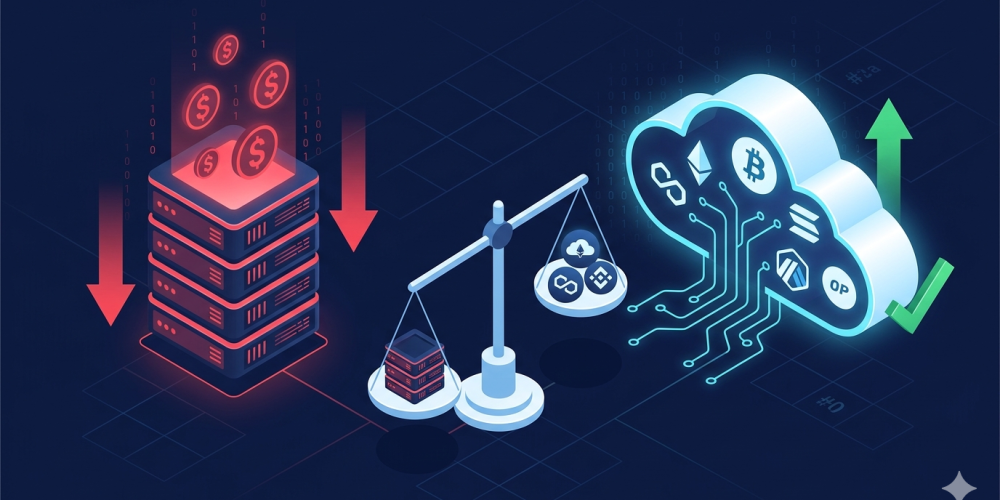
Running self-hosted RPC nodes in 2026 costs the average mid-size Web3 team $18,000–$40,000/year in infrastructure alone — before you account for DevOps hours, downtime events, and multi-chain sprawl. The build-vs-buy calculus has shifted dramatically, and most engineering teams are still doing it wrong. Here's a hard-numbers breakdown of what reliable RPC infrastructure actually costs.
A production-grade Ethereum archive node requires 4–8 TB NVMe storage (growing ~1 TB/year), 32+ GB RAM, and dedicated bandwidth — roughly $600–$1,200/month on AWS or equivalent bare metal. Multiply that across the 5–10 chains a typical DeFi protocol supports in 2026, and you're at $3,000–$8,000/month in pure infrastructure spend before a single engineer touches the stack. EVM-compatible chains like Berachain (the berachain/polaris framework is trending hard on GitHub right now) are proliferating faster than ops teams can onboard them — every new chain is another node to provision, monitor, and patch.
A 2025 survey found Web3 engineering teams spend ~22% of sprint capacity on node maintenance, sync issues, and RPC reliability incidents. A single archive node sync failure during an Ethereum hard fork averages 4–7 hours of downtime. True total cost of ownership for self-hosted RPC infrastructure runs 2.3–3.1x the raw compute line item. That's not infrastructure spend — that's product velocity you're burning.
Crypto APIs' Node-as-a-Service covers 60+ blockchain networks with dedicated nodes, automatic failover, and 99.9% uptime SLAs. Teams report cutting blockchain infrastructure spend by 55–70% vs. self-hosted while gaining access to chains they couldn't justify running independently.
The benchmark math is straightforward: $500–$2,000/month for managed NaaS versus $8,000+/month for the DIY equivalent at scale. For multi-chain DeFi protocols or fintech platforms integrating more than three networks, break-even on managed nodes hits in under 45 days.
Beyond raw RPC, the same API key unlocks a complete blockchain data layer — eliminating the parallel infrastructure most teams forget to budget for:
Building any of those in-house is another 6–12 months of engineering on top of the node infrastructure itself. The integration entry point is documented in Getting Started and Authentication.
If your team integrates more than three chains, ships features faster than DevOps can provision, or has any service-level commitment to uptime → managed NaaS wins on every axis. The chains keep multiplying. Your ops budget shouldn't have to.
👉 Explore Crypto APIs' Node-as-a-Service plans and chain coverage — or compare pricing tiers directly.
#Web3Infrastructure #RPCNodes #NodeAsAService #BlockchainDevelopment #DeFi #Web3DevOps
Networks Supported
Avg Processing Time
Enterprise-ready
of Big Data




 Copy link