



Infrastructure optimized for growth

35+
Networks Supported

25ms
Avg Processing Time

25,000+ rq/s
Enterprise-ready

100+ TB
of Big Data

 Sign in

Access to full transaction data on all transactions & addresses

Retrieve blockchain data, balances, and transactions

Detailed blockchain history and transaction data for any address.

Full smart contracts metadata, including token symbols & token names

Access to full transaction data on all transactions & addresses

Get live crypto prices, exchange rates, supply and token contracts across protocols via one REST API.

Real-time notifications for events on top blockchains. Response under 100ms.

AML address screening across 35+ networks

Sync and manage HD wallets, keys and addresses

Local signing for EVM, UTXO, Tron, XRP, Kaspa and Solana

Precise blockchain transaction fee estimates based on transaction priority

Broadcast and verify transactions with real-time monitoring

Prepare EVM transactions, including token transfers

Test EVM transactions, optimize gas fees and identify security flaws

Pay for HTTP APIs, or charge for your own, in USDC stablecoin over the open x402 protocol — non-custodial, on-chain settlement.

MCP servers, CLI and skills for AI agents

Dedicated nodes infrastructure for leading blockchains using JSON-RPC

Address validation, encoding & cryptographic tasks optimizations

Shared node infrastructure for top blockchains using JSON-RPC.

Jun 3, 2026 • 6 min

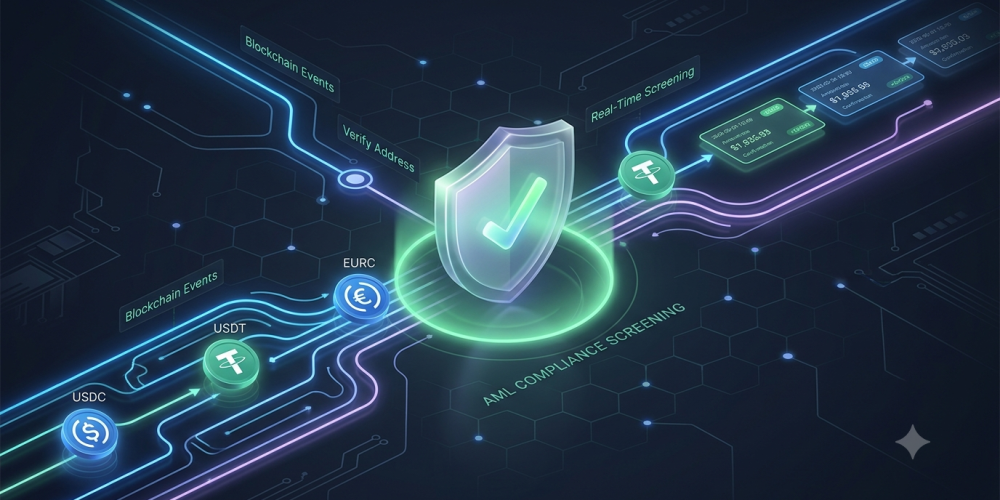
Stablecoins processed over $27.6 trillion in on-chain volume in 2025 — surpassing Visa's annual settlement figure. In 2026, USDC, USDT, and the newly prominent EURC aren't experimental instruments. They are operational payment rails inside exchanges, neobanks, crypto PSPs, and cross-border remittance platforms.
And with that scale comes an unavoidable reality: regulators are no longer waiting.
The EU's Markets in Crypto-Assets (MiCA) regulation entered full enforcement in June 2026. The FATF Travel Rule now applies to Virtual Asset Service Providers (VASPs) in over 40 jurisdictions. The US Financial Crimes Enforcement Network (FinCEN) expanded its crypto monitoring perimeter in Q1 2026. If your platform touches stablecoins at any scale, your AML screening pipeline is either compliant in real time — or it's a liability.
This guide is for developers and infrastructure teams building or hardening stablecoin payment stacks. We'll walk through the three critical compliance layers, the failure modes that create regulatory exposure, and exactly how to wire each layer using Crypto APIs.
Most teams start with a reasonable assumption: screen wallet addresses before accepting a payment, and you're done. That works for low-volume, single-chain deployments. It falls apart fast in production for three reasons.
Stablecoins move across chains. USDC is natively issued on Ethereum, Solana, Base, Avalanche, Arbitrum, Polygon, and more. USDT runs on Tron, Ethereum, BNB Chain, and others. A sanction-listed entity doesn't care which chain you're watching — they route through the one you aren't.
Risk is transaction-level, not address-level. An address might be clean when you screen it. The next incoming transaction could originate from a mixer, a flagged exchange, or a sanctioned intermediary. Static, one-time screening misses this entirely.
MiCA and FATF require chain-of-custody evidence. It's not enough to say "we screened this address." Regulators want audit trails: what was screened, when, against which list version, and what triggered any hold or rejection.
Each of these problems has a solution at the infrastructure layer. Let's build them.
The first gate is address-level screening — but doing it correctly means going beyond a simple blocklist check. When a payer submits a withdrawal or payment request, your pipeline should call the Verify Address API before initiating any on-chain action. This endpoint screens a wallet address across 35+ networks against global sanctions lists, PEP databases, and risk-scoring models — returning a risk verdict in milliseconds.
The response gives you a risk classification, match metadata, and the list sources triggered. Your payment logic gates on this result before any transaction preparation begins. Coverage includes OFAC SDN, EU sanctions, UN consolidated list, and proprietary risk signals from on-chain behavior analysis.
For a full breakdown of products and supported chains, see the API documentation overview.
Static screening is a snapshot. Compliance in 2026 requires a live feed.
The Blockchain Events API lets you subscribe to real-time webhook notifications for on-chain activity — new blocks, unconfirmed transactions, specific address activity, or custom confirmation thresholds. Delivery latency is under 100ms. You don't run a node; the infrastructure is fully managed.
For a stablecoin compliance pipeline, you subscribe to incoming and outgoing transactions for every customer address in your system. When an event fires, your webhook handler receives the transaction payload, extracts all counterparty addresses, and runs each through Verify Address screening. If a risk flag is raised mid-flight, your system can freeze the corresponding customer account pending review — before the transaction confirms.
This architecture turns compliance from a one-time gate into a continuous monitoring loop. It also generates the audit trail regulators need: every event received, every address screened, every decision logged, all timestamped. You can replicate this subscription pattern across Ethereum, Bitcoin, BNB Chain, Polygon, Avalanche, Tron, Solana, and a dozen other chains — all from a single API key, without spinning up separate nodes per chain.
For details on callback structure, retry logic, and security signatures, see the Callbacks documentation.
For higher-risk payments — large amounts, new counterparties, jurisdictions under enhanced due diligence — address-level and event-level screening isn't sufficient. You need to understand the history of funds.
The Transactions Data API lets you trace transaction-level details across chains: inputs and outputs, all participating addresses, gas fees, status, internal transactions, and cross-chain swaps. For a $500K USDC payment, you can pull the full transaction graph and check whether any upstream address in the last N hops is flagged.
The Address History API gives you full on-chain history back to genesis block — every transaction, token transfer (ERC-20, NFTs), and smart contract interaction for any address. This enables FATF Travel Rule compliance by letting you establish the full chain-of-custody for large stablecoin movements and demonstrate to auditors that enhanced due diligence was performed.
MiCA doesn't distinguish between chains. If you operate a stablecoin payment service under its scope, your compliance obligations apply regardless of which blockchain the transaction runs on. A team that has perfect Ethereum screening but no Tron coverage is still non-compliant when a customer submits a USDT-TRC20 payment.
Crypto APIs' infrastructure covers 35+ networks with a unified API interface. You write the screening logic once. The same code path handles Ethereum, Tron, Solana, BNB Chain, Polygon, Avalanche, and others — same endpoints, same response schema, same webhook format. View the full list of supported blockchains and networks.
There's a subtle but critical timing issue that catches teams off guard: the gap between transaction broadcast and transaction finality.
When you call the Broadcast Transactions API to submit a signed stablecoin transaction to the network, the transaction is in the mempool — visible, but not confirmed. Depending on network congestion, this window can be 15 seconds on Ethereum, several minutes on Bitcoin, or variable on L2s during sequencer delays.
Blockchain Events supports custom confirmation thresholds per subscription. You can configure webhooks to fire at 1, 3, 6, or custom confirmation counts — aligning your "funds released" trigger with your risk policy, not just with broadcast success. This is the architecture that closes the compliance window and gives your team defensible evidence that funds were not released prematurely.
Every compliance interaction — address screened, risk score returned, event received, decision made — needs to be logged with a timestamp, the data version used, and the outcome. MiCA Article 83 and the FATF Travel Rule both require VASPs to demonstrate that screening was performed, not just assert it.
Your logging schema should capture: the address screened with blockchain and timestamp; the risk verdict, list version, and any match metadata; the transaction ID associated with the screening event; and the decision outcome (pass, hold, or reject) with a reason code. Crypto APIs' responses include structured metadata you can pipe directly into your compliance log store — combined with Blockchain Events webhook payloads (which include block height, timestamp, transaction hash, and confirmation count) you have a complete, reconstructible audit trail.
If you're building or upgrading a stablecoin payment compliance pipeline, the fastest path to production is:
Start with Verify Address for synchronous pre-payment screening across 35+ networks. Add Blockchain Events subscriptions for your active customer addresses for continuous monitoring. Integrate Transactions Data and Address History for enhanced due diligence on high-value flows.
Review the Getting Started guide in the developer documentation, then create your free account to get your API key and begin integrating today.
The three-layer architecture described here — screen before, monitor during, investigate when needed — gives you a compliance posture that holds up under MiCA, FATF, and whatever the next regulatory wave brings. Because in 2026, the question isn't whether your stablecoin pipeline will face a compliance review. It's whether your infrastructure will be ready when it does.
Networks Supported
Avg Processing Time
Enterprise-ready
of Big Data



 Copy link