



Infrastructure optimized for growth

35+
Networks Supported

25ms
Avg Processing Time

25,000+ rq/s
Enterprise-ready

100+ TB
of Big Data

 Sign in

Access to full transaction data on all transactions & addresses

Retrieve blockchain data, balances, and transactions

Detailed blockchain history and transaction data for any address.

Full smart contracts metadata, including token symbols & token names

Access to full transaction data on all transactions & addresses

Get live crypto prices, exchange rates, supply and token contracts across protocols via one REST API.

Real-time notifications for events on top blockchains. Response under 100ms.

AML address screening across 35+ networks

Sync and manage HD wallets, keys and addresses

Local signing for EVM, UTXO, Tron, XRP, Kaspa and Solana

Precise blockchain transaction fee estimates based on transaction priority

Broadcast and verify transactions with real-time monitoring

Prepare EVM transactions, including token transfers

Test EVM transactions, optimize gas fees and identify security flaws

Pay for HTTP APIs, or charge for your own, in USDC stablecoin over the open x402 protocol — non-custodial, on-chain settlement.

MCP servers, CLI and skills for AI agents

Dedicated nodes infrastructure for leading blockchains using JSON-RPC

Address validation, encoding & cryptographic tasks optimizations

Shared node infrastructure for top blockchains using JSON-RPC.

Jun 1, 2026 • 3 min

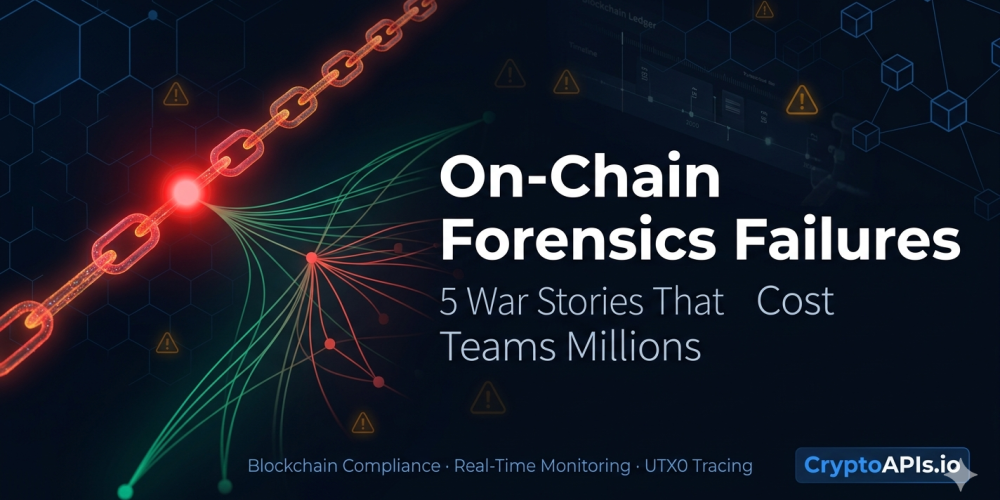
Most blockchain forensics postmortems share a common thread: teams had the data, but lacked the infrastructure to act on it in time. From missing UTXO traces to delayed webhook alerts, the gap between raw chain data and actionable intelligence has quietly drained millions from projects that thought they were protected.
The most expensive on-chain forensics failures in 2025–2026 weren't caused by sophisticated exploits — they were caused by blind spots in data pipelines. If your compliance stack still relies on polling nodes every 60 seconds, you're operating forensics theater, not real-time protection.
A DeFi protocol lost $4.2M after a draining transaction propagated across 14 hops on three chains before their monitoring script caught it — 23 minutes too late. Their forensics stack was polling a public node every 60 seconds. By the time the alert fired, the attacker had already bridged funds to a mixer.
The lesson: block-level confirmation polling is forensics theater. Real compliance infrastructure requires mempool-level visibility, not block-level lagging. CryptoAPIs' Blockchain Events API — New Unconfirmed Transactions delivers webhook alerts for mempool-detected transactions before a block ever confirms. That's the difference between catching an exploit and reading about it in a postmortem.
An exchange compliance team flagged a wallet for suspicious activity — but their tooling only checked one hop. The flagged address had interacted with 340 intermediate addresses across Bitcoin and Ethereum before funds reached their deposit address. By the time their in-house scraper surfaced the connection, the withdrawal had already processed.
True UTXO and EVM address graph traversal requires multi-hop tracing across 60+ chains simultaneously. The Address History UTXO API provides full historical transaction data from the Genesis block onward — including complete UTXO input/output graphs — without requiring teams to run their own archive nodes. For EVM chains, the Address History EVM API covers token transfers (NFTs/ERC-20) and smart contract interactions.
A compliance fintech company spent three weeks rebuilding their custom ETH parser after a network upgrade changed internal transaction formats. Their monitoring went dark for 19 days — precisely the window an exploit team needed to launder $1.8M through their platform undetected.
Teams building in-house scrapers routinely underestimate the maintenance burden. Using a purpose-built Transactions Data API (EVM) eliminates this failure mode entirely. For UTXO chains, the Transactions Data API (UTXO) returns full input/output graphs across Bitcoin, Litecoin, Dash and more — CryptoAPIs normalizes data across 60+ chains, so your forensics workflow doesn't break when a chain upgrades.
A crypto custody provider had a rule: only alert on confirmed transactions. Seemed safe. Then an attacker submitted a high-fee double-spend attempt that propagated through the mempool and was detected by their risk team — after the window to reject the associated withdrawal had closed.
Monitoring unconfirmed transactions is not optional for serious compliance stacks. The Callbacks (Webhooks) documentation explains how CryptoAPIs supports both confirmed and unconfirmed transaction events. Pair it with New Confirmed Coins Transactions And Each Confirmation to catch every confirmation step — not just the final one.
A Web3 payment processor was monitoring Ethereum and Bitcoin — but not Polygon or BNB Chain. An attacker routed stolen funds through a Polygon bridge, bypassing all alerts. The compliance team didn't know until a law enforcement inquiry arrived weeks later.
Multi-chain coverage is not a luxury. Check the What We Support page for the full list of 60+ blockchain networks covered by CryptoAPIs — including Ethereum, Bitcoin, Polygon, BNB Chain, Litecoin, Dash, Solana, and more. One API integration, full multi-chain visibility.
The common thread in all five failures: reactive infrastructure built on polling, single-chain coverage, or fragile custom parsers. Production-grade on-chain forensics requires:
CryptoAPIs.io is built for exactly this use case. Start with the Getting Started guide and have your first address watcher live in under 30 minutes.
👉 Explore the full CryptoAPIs.io Documentation Overview and build sub-3-second compliance alerts across 60+ chains today.
Networks Supported
Avg Processing Time
Enterprise-ready
of Big Data



 Copy link