



Infrastructure optimized for growth

35+
Networks Supported

25ms
Avg Processing Time

25,000+ rq/s
Enterprise-ready

100+ TB
of Big Data

 Sign in

Access to full transaction data on all transactions & addresses

Retrieve blockchain data, balances, and transactions

Detailed blockchain history and transaction data for any address.

Full smart contracts metadata, including token symbols & token names

Access to full transaction data on all transactions & addresses

Get live crypto prices, exchange rates, supply and token contracts across protocols via one REST API.

Real-time notifications for events on top blockchains. Response under 100ms.

AML address screening across 35+ networks

Sync and manage HD wallets, keys and addresses

Local signing for EVM, UTXO, Tron, XRP, Kaspa and Solana

Precise blockchain transaction fee estimates based on transaction priority

Broadcast and verify transactions with real-time monitoring

Prepare EVM transactions, including token transfers

Test EVM transactions, optimize gas fees and identify security flaws

Pay for HTTP APIs, or charge for your own, in USDC stablecoin over the open x402 protocol — non-custodial, on-chain settlement.

MCP servers, CLI and skills for AI agents

Dedicated nodes infrastructure for leading blockchains using JSON-RPC

Address validation, encoding & cryptographic tasks optimizations

Shared node infrastructure for top blockchains using JSON-RPC.

May 5, 2026 • 2 min


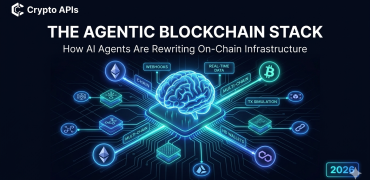
The swapper-toolkit repository — a DeFi toolkit explicitly built for AI agents like Claude Code, AutoGPT, and CrewAI to deposit funds, execute trades, and manage wallets — hit 704 GitHub stars in days. When autonomous agents are executing on-chain at machine speed, your API layer has to be built for it. By Q1 2026, on-chain activity attributable to AI agent wallets had grown to an estimated 8–12% of total DeFi transaction volume on EVM chains. This isn't a future scenario. It's live.
AI agents don't browse documentation — they call APIs in tight loops with zero tolerance for rate limits, latency spikes, or ambiguous error responses. A human developer retries a failed transaction manually; an AutoGPT trading agent will either loop into an error spiral or silently fail mid-strategy. That changes the requirements completely:
Crypto APIs ships native AI compatibility — not as an afterthought, but as a first-class product layer. The MCP Servers implementation lets Claude, Cursor, and any MCP-compatible agent talk to blockchain data through structured tool calls. The n8n MCP Client drops blockchain operations directly into your agent orchestration workflows. That's the difference between gluing an LLM to REST docs and shipping a production-grade autonomous trading system.
The failure modes are predictable, and they're already showing up in production:
Building AI-agent-ready DeFi infrastructure means treating your blockchain API layer as a mission-critical real-time system, not a convenience layer. Crypto APIs is architected for exactly this: deterministic address derivation for agent wallet isolation, real-time transaction event webhooks, and consistent sub-150ms broadcast latency across 60+ chains. Teams building autonomous trading agents or AI-managed treasury systems can use Crypto APIs to handle the on-chain plumbing while keeping agent logic in their preferred AI framework. Start with the Getting Started guide and grab credentials via Authentication.
The market is moving fast: the teams that get the infrastructure layer right now will own the autonomous DeFi stack in 12 months.
👉 Explore Crypto APIs' AI-Compatible Endpoints and start building autonomous DeFi agents today. See pricing plans.
#DeFi #AIAgents #Web3Infrastructure #BlockchainAPI #AutonomousTrading #MCPServers
Networks Supported
Avg Processing Time
Enterprise-ready
of Big Data



 Copy link