



Infrastructure optimized for growth

35+
Networks Supported

25ms
Avg Processing Time

25,000+ rq/s
Enterprise-ready

100+ TB
of Big Data

 Sign in

Access to full transaction data on all transactions & addresses

Retrieve blockchain data, balances, and transactions

Detailed blockchain history and transaction data for any address.

Full smart contracts metadata, including token symbols & token names

Access to full transaction data on all transactions & addresses

Get live crypto prices, exchange rates, supply and token contracts across protocols via one REST API.

Real-time notifications for events on top blockchains. Response under 100ms.

AML address screening across 20+ blockchains

Sync and manage HD wallets, keys and addresses

Local signing for EVM, UTXO, Tron, XRP, Kaspa and Solana

Precise blockchain transaction fee estimates based on transaction priority

Broadcast and verify transactions with real-time monitoring

Prepare EVM transactions, including token transfers

Test EVM transactions, optimize gas fees and identify security flaws

Pay for HTTP APIs, or charge for your own, in USDC stablecoin over the open x402 protocol — non-custodial, on-chain settlement.

MCP servers, CLI and skills for AI agents

Dedicated nodes infrastructure for leading blockchains using JSON-RPC

Address validation, encoding & cryptographic tasks optimizations

Shared node infrastructure for top blockchains using JSON-RPC.

Apr 24, 2026 • 4 min

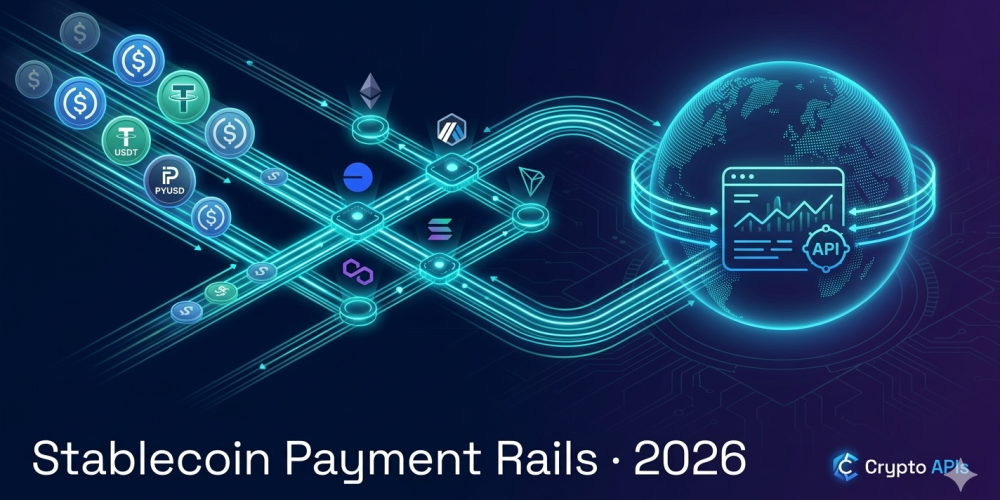
Stablecoins have graduated from a crypto curiosity to the default settlement layer of the internet. By Q1 2026, on-chain stablecoin transfer volume has surpassed Visa's annual throughput on multiple measurement days, and enterprises from fintech neobanks to global marketplaces are racing to plug stablecoin rails into payouts, payroll, remittances, and merchant settlement. The question for product and engineering teams is no longer should we support stablecoin payments — it is how do we ship a compliant, low-latency, multi-chain payment rail without rebuilding blockchain infrastructure from scratch?
This article breaks down the architecture of a modern stablecoin payment rail, the APIs you need at each layer, and how Crypto APIs maps directly to every component — from address generation and balance monitoring to transaction simulation, broadcasting, and real-time webhook alerts.
Three forces are converging right now. First, regulatory clarity in the United States and the European Union has unlocked enterprise adoption; USDC, USDT, PYUSD, and bank-issued tokens are being treated as legitimate settlement instruments rather than speculative assets. Second, Layer 2 networks and high-throughput chains such as Base, Arbitrum, Polygon, Solana, and Tron have driven per-transaction costs to fractions of a cent, finally making micro-payouts economically viable. Third, businesses are fatigued by correspondent-banking delays and card-network fees, and stablecoins offer near-instant, 24/7 settlement across borders.
For developers, this means a massive greenfield opportunity — but also a deceptively complex stack to build.
A production-grade stablecoin payment system generally needs seven capabilities: deterministic wallet generation per customer, real-time balance and deposit detection, historical reconciliation, gas-aware fee estimation, transaction pre-simulation, reliable broadcasting, and event-driven notifications for ops and accounting. Each of these maps cleanly to a Crypto APIs product, which is why teams increasingly skip the in-house node cluster and go straight to a unified REST layer. You can browse the full surface in the Crypto APIs REST documentation overview.
Issuing a unique deposit address for every user is table stakes for reconciliation, AML, and user experience. Hierarchical deterministic wallets let you derive millions of addresses from a single extended public key — no private key exposure, no manual bookkeeping. Crypto APIs' HD Wallets Management suite handles address derivation, synchronization, and balance tracking across 15+ chains, which means a single integration covers ETH, Base, Arbitrum, Polygon, BSC, Tron, Bitcoin, and more.
The moment a customer funds their address, your application needs to know — not five minutes later. Polling block explorers is fragile and expensive; webhook-driven architecture is the modern answer. With Blockchain Events, you subscribe to new blocks, unconfirmed transactions, or specific address activity and receive sub-100ms webhook deliveries with custom confirmation thresholds. For teams that still need pull-based access, the Address Latest endpoints return the last 14 days of activity with one-block confirmation freshness.
Regulated payment flows require audit trails that survive migrations, disputes, and tax season. The Address History product exposes full data from the genesis block forward, including ERC-20 transfers, NFT movements, and internal transactions — the raw material for forensic analysis, Travel Rule reporting, and monthly close. Pair it with Transactions Data to trace the full journey of any payout, including cross-chain swaps and gas refunds.
A payout that sits in the mempool for 20 minutes is indistinguishable from a failure to the end user. Dynamic, congestion-aware fee estimation is the difference between a premium product and a frustrating one. The Blockchain Fees endpoints return tiered recommendations (slow, standard, fast) across ETH, BTC, and Layer 2 networks so your backend can optimize against a budget or a service-level target.
Nothing erodes customer trust faster than a failed on-chain transaction that still burns gas. Before you broadcast, simulate. The Simulate Transactions endpoint runs EVM transactions against the current state of Ethereum, Polygon, or BNB Chain, returning expected outcomes, gas usage, and revert reasons. This single call catches insufficient allowances, frozen tokens, and contract reverts before a single wei is spent.
Once you are confident the transaction will succeed, sign it and push it through Broadcast Transactions. Built-in retry logic and mempool tracking protect you from stuck nonces and orphaned broadcasts — two of the most common causes of late-night pages on a stablecoin payments team.
Sending a payout to a malformed address is an irreversible mistake. Blockchain Utils provides address validation and X-Address encoding, while Contracts Data returns token metadata — symbol, decimals, supply — in roughly 25 milliseconds, so your UI never displays "0.000000001 USDC" because someone forgot to divide by ten to the sixth.
A payment engineer shipping on this stack would wire the flow as follows. The user requests a payout; the backend validates the destination via Blockchain Utils, fetches current fee tiers from Blockchain Fees, and simulates the transaction with Simulate Transactions. If simulation succeeds, the service signs the payload, broadcasts it, and registers a webhook subscription through Blockchain Events. A confirmation event triggers the ledger update, the notification to the customer, and the accounting entry — all within seconds, and all without operating a single blockchain node.
Teams that adopt an API-first stablecoin stack ship in weeks rather than quarters, avoid the six-figure annual cost of running archive nodes across a dozen chains, and retain the flexibility to add networks as the market shifts. They also gain something harder to price: a predictable SLA on the parts of the stack that are easiest to get wrong — syncing nodes, reorg handling, fee spikes, and webhook reliability.
Stablecoins are on track to become the default rail for internet-native money movement. The companies that win this wave will not be the ones who built the best node cluster — they will be the ones who shipped the best product on top of a reliable abstraction. If you are ready to build, start with the Crypto APIs documentation overview and wire your first payout in an afternoon.
Networks Supported
Avg Processing Time
Enterprise-ready
of Big Data




 Copy link