



Infrastructure optimized for growth

35+
Networks Supported

25ms
Avg Processing Time

25,000+ rq/s
Enterprise-ready

100+ TB
of Big Data

 Sign in

Access to full transaction data on all transactions & addresses

Retrieve blockchain data, balances, and transactions

Detailed blockchain history and transaction data for any address.

Full smart contracts metadata, including token symbols & token names

Access to full transaction data on all transactions & addresses

Get live crypto prices, exchange rates, supply and token contracts across protocols via one REST API.

Real-time notifications for events on top blockchains. Response under 100ms.

AML address screening across 20+ blockchains

Sync and manage HD wallets, keys and addresses

Local signing for EVM, UTXO, Tron, XRP, Kaspa and Solana

Precise blockchain transaction fee estimates based on transaction priority

Broadcast and verify transactions with real-time monitoring

Prepare EVM transactions, including token transfers

Test EVM transactions, optimize gas fees and identify security flaws

Pay for HTTP APIs, or charge for your own, in USDC stablecoin over the open x402 protocol — non-custodial, on-chain settlement.

MCP servers, CLI and skills for AI agents

Dedicated nodes infrastructure for leading blockchains using JSON-RPC

Address validation, encoding & cryptographic tasks optimizations

Shared node infrastructure for top blockchains using JSON-RPC.

Apr 2, 2026 • 2 min

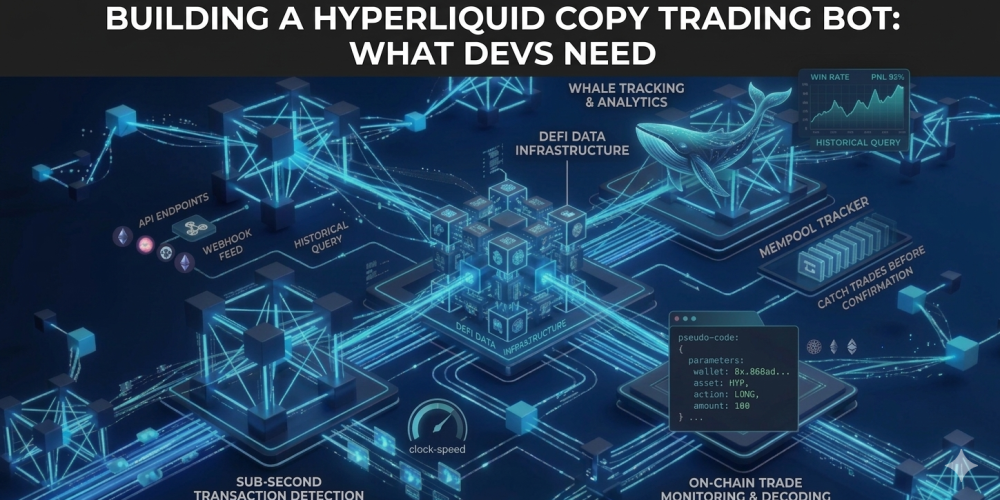
Copy trading bots on Hyperliquid are exploding in 2026 — and the GitHub activity proves it. But most teams hit the same wall: getting reliable, low-latency on-chain data fast enough to make copy trading actually work.
Hyperliquid's perpetuals DEX processes thousands of trades per second across a fully on-chain order book. A copy trading bot has one job: detect a target wallet's trade, parse it, and mirror it before slippage kills your edge. That means your data pipeline needs sub-second transaction detection, decoded event logs, and wallet activity tracking — not block-polling every 2 seconds.
Most developers underestimate this bottleneck until they're already in production and watching alpha evaporate.
Here's what a production-grade copy trading stack looks like in 2026:
You need to track a target wallet the moment it moves — not after the next block. The List Confirmed Transactions by Address (EVM) endpoint gives you all recent activity for any EVM address, updated with every new block. Pair it with the Blockchain Events webhook subscriptions to receive push notifications the moment a confirmed transaction hits your target wallet — no polling, no missed trades.
A copy bot needs to understand what was traded, not just that a transaction occurred. The Get Transaction Details by Hash (EVM) endpoint returns fully decoded input data, internal calls, and token transfer details. List Logs by Transaction Hash (EVM) gives you the decoded event logs — critical for parsing DEX swap events and identifying the exact trade parameters to mirror.
The real edge in copy trading comes from catching unconfirmed transactions. New Unconfirmed Coins Transactions webhook subscriptions let you react to a mempool broadcast before block inclusion — shaving critical milliseconds off your response time.
The teams shipping fastest aren't building their own node infrastructure. CryptoAPIs provides all of this: real-time webhook subscriptions for wallet address activity, confirmed and unconfirmed transaction feeds, and decoded on-chain data across 60+ supported chains. That's the difference between a bot that mirrors trades in 300ms versus 3 seconds.
The best copy trading bots aren't just mirroring — they're filtering. Before you copy any wallet, you need historical performance data: win rate, average position size, PnL over time. That requires deep historical blockchain data queries, not just live feeds.
The List Confirmed Transactions by Address — History (EVM) endpoint gives you a full transaction history from genesis block onward for any EVM address. Combined with List Tokens by Address (EVM) to analyze historical token holdings, you can score and rank wallets before committing to copy them.
Combining historical analytics with real-time streaming is where most DIY setups fall apart. A unified API layer that handles both — all documented in the CryptoAPIs developer overview — dramatically cuts your time to a working, profitable bot.
Explore CryptoAPIs' real-time transaction streaming and wallet monitoring endpoints to start building your copy trading infrastructure today.
Networks Supported
Avg Processing Time
Enterprise-ready
of Big Data



 Copy link