



Infrastructure optimized for growth

35+
Networks Supported

25ms
Avg Processing Time

25,000+ rq/s
Enterprise-ready

100+ TB
of Big Data

 Sign in

Access to full transaction data on all transactions & addresses

Retrieve blockchain data, balances, and transactions

Detailed blockchain history and transaction data for any address.

Full smart contracts metadata, including token symbols & token names

Access to full transaction data on all transactions & addresses

Get live crypto prices, exchange rates, supply and token contracts across protocols via one REST API.

Real-time notifications for events on top blockchains. Response under 100ms.

AML address screening across 35+ networks

Sync and manage HD wallets, keys and addresses

Local signing for EVM, UTXO, Tron, XRP, Kaspa and Solana

Precise blockchain transaction fee estimates based on transaction priority

Broadcast and verify transactions with real-time monitoring

Prepare EVM transactions, including token transfers

Test EVM transactions, optimize gas fees and identify security flaws

Pay for HTTP APIs, or charge for your own, in USDC stablecoin over the open x402 protocol — non-custodial, on-chain settlement.

MCP servers, CLI and skills for AI agents

Dedicated nodes infrastructure for leading blockchains using JSON-RPC

Address validation, encoding & cryptographic tasks optimizations

Shared node infrastructure for top blockchains using JSON-RPC.

Mar 23, 2026 • 2 min

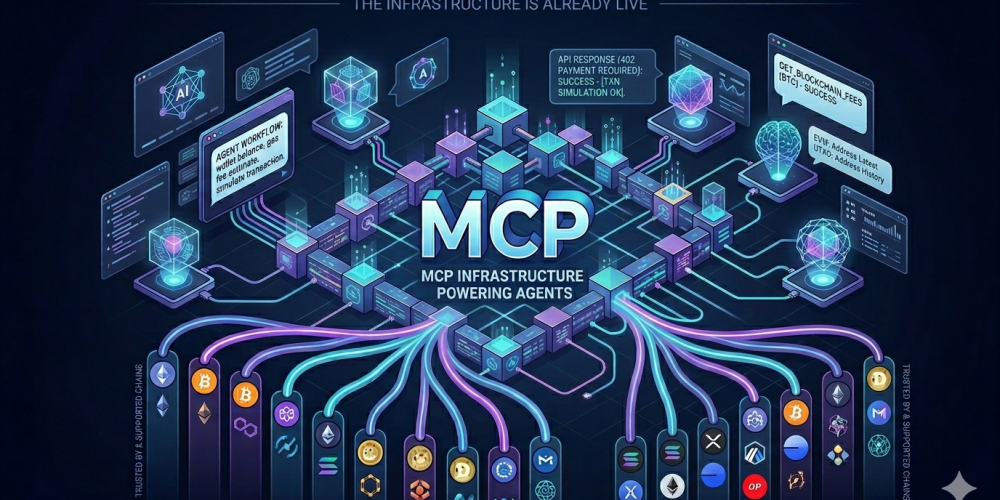
Something is quietly reshaping the API economy — and most builders haven't caught up yet.
AI agents are no longer waiting for a human to click "query." They're spinning up, executing blockchain reads, checking wallet balances, estimating gas fees, and broadcasting transactions — all autonomously. No signup forms. No welcome emails. No $50K/year contracts.
The HTTP 402 status code — "Payment Required" — has sat largely unused since 1997. It was designed for exactly this: machine-to-machine micropayments. Now, with agentic AI frameworks maturing across Claude, ChatGPT, Gemini, and Copilot, that code is finally finding its moment. Coinbase noticed. AWS noticed. Anthropic noticed.
The question isn't whether AI agents will consume blockchain data — it's whether your infrastructure can serve them.
At Crypto APIs, we've been building for this moment since 2018. Not because we predicted 402 would go mainstream, but because the principles behind it — lightweight access, zero friction, real-time response — are exactly what good blockchain infrastructure should deliver regardless of who (or what) is calling it.
Agents operating autonomously need infrastructure that is deterministic and fast. A 25ms average processing time isn't a vanity metric — it's the difference between an agent completing a workflow in one second or ten. They need multi-chain coverage without juggling multiple providers: our MCP Servers now support EVM chains (Ethereum, BSC, Polygon, Arbitrum, Base, Optimism), UTXO chains (Bitcoin, Litecoin, Dogecoin), XRP, Solana, and Kaspa — all through a single integration point.
They need reliable on-chain reads. Address Latest for current balances and nonces. Address History for full transaction trails. Block Data and Transactions Data for precise on-chain state. They need fee intelligence — Blockchain Fees with EIP-1559 support and UTXO estimates — so agents can make economically rational decisions without guessing. They need the ability to simulate before executing: our Transaction Simulator lets agents dry-run EVM transactions, see exact gas usage and state changes, before committing a single byte to the chain.
And critically, they need event-driven triggers. Blockchain Events delivers real-time webhook notifications — confirmed transactions, new blocks, token transfers, address activity — under 100ms response time. That's the nervous system of any autonomous agent loop.
Crypto APIs is trusted by top Web3 companies — past and present — including Tangem, Nexo, Fidelity, Ledger, Julius Baer, PayPal, Chainlink, and 500+ innovators worldwide.. Over 100 TB of blockchain data. 25,000+ requests per second at enterprise scale. A free plan that lets you start immediately, and flexible Pay As You Go pricing that scales with you — no $50K contracts, no locked-in tiers.
The infrastructure for what comes next isn't something that needs to be built. It's already live.
→ Start building: Crypto APIs
→ Explore MCP Servers: API Reference
Networks Supported
Avg Processing Time
Enterprise-ready
of Big Data





 Copy link