
Access to full transaction data on all transactions & addresses
Broadcast and verify transactions with real-time monitoring
Retrieve blockchain data, balances, and transactions
Detailed blockchain history and transaction data for any address.
Full smart contracts metadata, including token symbols & token names
Dedicated nodes infrastructure for leading blockchains using JSON-RPC
Address validation, encoding & cryptographic tasks optimizations
Shared node infrastructure for top blockchains using JSON-RPC.
Real-time notifications for events on top blockchains. Response under 100ms.
Precise blockchain transaction fee estimates based on transaction priority
Sync and manage HD wallets, keys and addresses
Prepare EVM transactions, including token transfers
Access to full transaction data on all transactions & addresses
Get access to unified market data using REST APIs from top crypto exchanges.
Test EVM transactions, optimize gas fees and identify security flaws
In our previous article, Can Ethereum 3.0 Finally Overcome Scalability Challenges, we explored the foundational elements of Ethereum’s long-term scalability roadmap, including proof-of-stake, modular execution, and the growing role of Layer 2 networks. That article established Ethereum 3.0 not as a single upgrade, but as a multi-year architectural transformation.
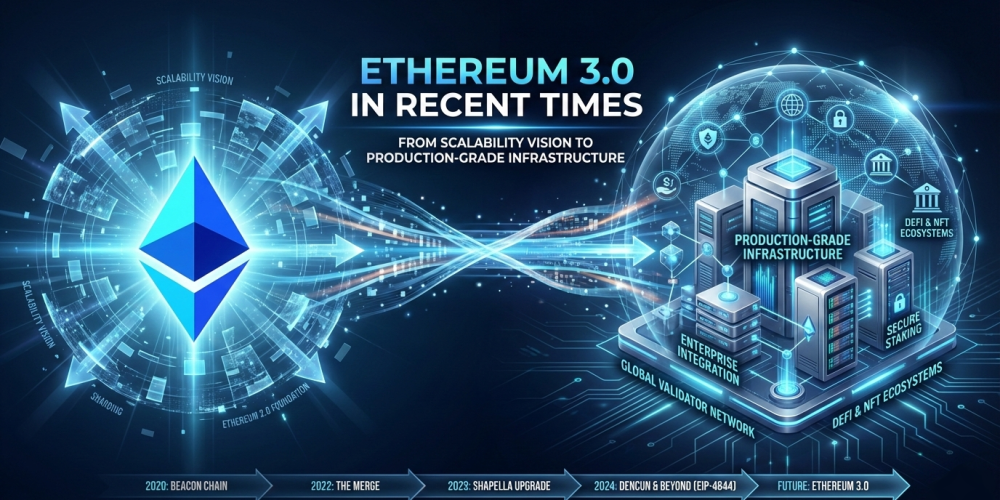
As we focus on 2025 and looking ahead at 2026, Ethereum is entering a more mature phase of this journey. Many of the concepts discussed earlier are now operational realities, while new priorities such as data availability, interoperability, and ecosystem reliability are shaping how developers and product teams evaluate Ethereum infrastructure. Ethereum 3.0 is no longer just about scaling transactions, but about scaling real-world usage in a sustainable and predictable way.
By 2025, Ethereum’s roadmap has fully embraced modularity. Rather than pushing all computation onto the base layer, Ethereum now focuses on security, consensus, and data availability at Layer 1, while execution and high-throughput activity increasingly happen on Layer 2 networks.
This shift represents a defining principle of Ethereum 3.0. Rollups process the majority of transactions, while Ethereum mainnet acts as the settlement and coordination layer. For developers, this means scalability is no longer tied to a single chain’s performance, but to how effectively applications interact across layers.
Crypto APIs plays a critical role in this environment. The Crypto APIs infrastructure suite has supported all changes with Ethereum as the network evolved, including Address Latest, Address History, Blockchain Events, as well as other services from the suite that enable consistent access to blockchain data across Ethereum mainnet and Layer 2 ecosystems. This allows teams to adapt to architectural changes without constantly reworking their backend systems.
Data availability has become one of the most important pillars of Ethereum scalability. With proto-danksharding significantly reducing rollup data costs, Layer 2 networks have become more affordable and predictable for users and developers alike. Looking toward 2026, continued improvements in data availability are expected to further strengthen Ethereum’s role as the backbone for rollup-based execution.
This evolution reinforces Ethereum 3.0’s long-term design. Layer 1 secures the system, rollups scale execution, and data availability upgrades keep costs manageable. From an infrastructure standpoint, this creates new requirements for visibility, monitoring, and analytics across multiple layers.
Crypto APIs supports these needs by ensuring that developers can track activity consistently as Ethereum upgrades roll out. Services such as Blockchain Events help teams monitor on-chain activity in near real time, while Address Latest provide up-to-date insights into balances and transactions as execution increasingly shifts to Layer 2 networks.
Another defining trend through 2025 and 2026 is the maturation of the Layer 2 ecosystem. Early experimentation has given way to clearer specialization. Some Layer 2 networks focus on general-purpose scalability, while others optimize for specific use cases such as payments, DeFi, or gaming.
This specialization aligns with Ethereum 3.0’s broader philosophy. Scalability is achieved not by forcing every application into the same execution environment, but by allowing purpose-built layers to coexist under Ethereum’s security umbrella.
For product owners and project managers, this introduces strategic decisions around infrastructure compatibility and long-term flexibility. Crypto APIs enables teams to remain agnostic to individual Layer 2 implementations by providing standardized access across networks, reducing the risk of vendor or chain lock-in as the ecosystem continues to evolve.
By 2026, Ethereum is increasingly viewed as an enterprise-ready settlement layer rather than an experimental platform. Predictable upgrades, strong security guarantees, and a well-defined roadmap make Ethereum suitable for production systems that require long-term stability.
This maturity raises expectations for infrastructure providers. Teams building on Ethereum expect reliable data access, consistent APIs, and support for ongoing protocol changes. Crypto APIs has continuously supported Ethereum upgrades, ensuring that services remain aligned with the latest protocol developments and network changes.
By integrating services such as Address Latest, Address History, Blockchain Events, and other components of the Crypto APIs suite, organizations can build systems that scale alongside Ethereum without needing to manage complex node infrastructure themselves.
Ethereum 3.0’s evolution highlights an important shift. Scalability is no longer just a protocol-level concern, it is an architectural and operational consideration. Teams that succeed on Ethereum are those that plan for modular execution, multi-layer interaction, and long-term infrastructure adaptability.
Choosing the right infrastructure partner is a key part of that strategy. Crypto APIs enables developers and product teams to stay focused on building user-facing functionality while relying on a proven infrastructure layer that evolves in step with Ethereum.
As we emphasized in the earlier article, Ethereum 3.0 is not a milestone but an ongoing process. Through 2025 and at the beginning of 2026, Ethereum continues to mature into a scalable, modular platform capable of supporting global applications at scale.
For teams navigating this transition, the question is no longer whether Ethereum can scale, but how to build confidently on top of that scalability. With comprehensive support for Ethereum upgrades and a robust blockchain infrastructure suite, Crypto APIs positions itself as an essential partner for developers and decision-makers building the next generation of Ethereum-based products.