



Infrastructure optimized for growth

35+
Networks Supported

25ms
Avg Processing Time

25,000+ rq/s
Enterprise-ready

100+ TB
of Big Data

 Sign in

Access to full transaction data on all transactions & addresses

Retrieve blockchain data, balances, and transactions

Detailed blockchain history and transaction data for any address.

Full smart contracts metadata, including token symbols & token names

Access to full transaction data on all transactions & addresses

Get live crypto prices, exchange rates, supply and token contracts across protocols via one REST API.

Real-time notifications for events on top blockchains. Response under 100ms.

AML address screening across 35+ networks

Sync and manage HD wallets, keys and addresses

Local signing for EVM, UTXO, Tron, XRP, Kaspa and Solana

Precise blockchain transaction fee estimates based on transaction priority

Broadcast and verify transactions with real-time monitoring

Prepare EVM transactions, including token transfers

Test EVM transactions, optimize gas fees and identify security flaws

Pay for HTTP APIs, or charge for your own, in USDC stablecoin over the open x402 protocol — non-custodial, on-chain settlement.

MCP servers, CLI and skills for AI agents

Dedicated nodes infrastructure for leading blockchains using JSON-RPC

Address validation, encoding & cryptographic tasks optimizations

Shared node infrastructure for top blockchains using JSON-RPC.

Feb 5, 2026 • 4 min

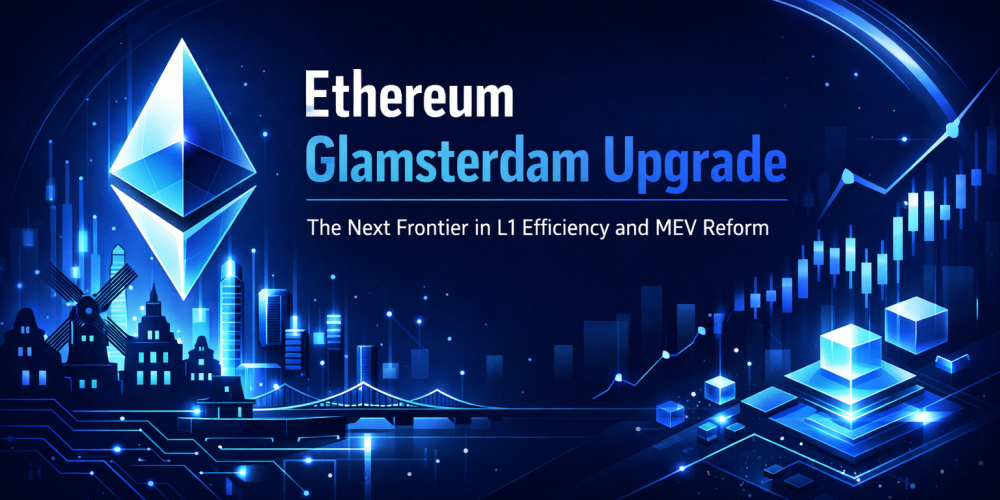
The Ethereum roadmap has entered a sophisticated new chapter. Following the successful deployment of the Fusaka upgrade in late 2025, the community’s focus has shifted toward Ethereum Glamsterdam, a major protocol milestone scheduled for the first half of 2026.
While previous upgrades like Dencun were celebrated for slashing Layer 2 (L2) costs, Glamsterdam is fundamentally an "L1-first" upgrade. It aims to harden the base layer’s decentralization, optimize execution efficiency, and reform how Maximum Extractable Value (MEV) is handled. For developers and enterprises using blockchain suite APIs, understanding these shifts is critical for maintaining high-performance decentralized applications (dApps).
At Crypto APIs, we are already monitoring the Glamsterdam devnets to ensure our Ethereum infrastructure is fully prepared to support our partners on day one.
The Glamsterdam upgrade is not just a collection of minor patches; it introduces structural changes to Ethereum’s engine. The goal is to move complex, off-chain processes directly into the protocol, a concept known as "enshrinement."
Currently, Ethereum validators rely on external software (MEV-Boost) and third-party "relays" to outsource block building to specialized actors. This has created a centralization bottleneck at the relay level.
Historically, Ethereum nodes process transactions one by one (sequentially) because they don’t know which accounts a transaction will touch until it actually runs.
While some features like Fork-choice Enforced Inclusion Lists (FOCIL) are being debated for either Glamsterdam or the subsequent Hegota upgrade, the direction is clear: giving validators the power to force the inclusion of transactions that block builders might otherwise ignore.
Ethereum has moved to a predictable, biannual upgrade schedule. Based on current core developer consensus, here is the projected timeline:
For those building on the network, Glamsterdam changes the "cost of doing business" in several beneficial ways. If you are integrating via APIs, you will notice a shift in how the network handles load.
With the introduction of EIP-7928, transaction execution becomes more deterministic. Because transactions must declare their access lists, developers can build more efficient smart contracts that avoid "hot spots", storage slots that many users touch at once. Applications that are well-isolated (i.e., they don't share state with high-traffic DEXs) will likely see more stable gas costs even during market volatility.
Building on the "blob" architecture introduced in earlier years, Glamsterdam’s efficiency gains at the execution layer allow for a more robust data environment. This is vital for developers utilizing blockchain suite APIs to track complex state changes or large-scale NFT mints.
Solo developers and small-scale staking operations will find it easier to participate in the MEV market without the overhead of managing complex external relay configurations.
As the Ethereum Glamsterdam upgrade approaches, reliability is the primary concern for any enterprise. Network upgrades often involve breaking changes in node APIs or execution logic that can disrupt service if not handled proactively.
Crypto APIs is committed to providing a seamless transition:
The Ethereum Glamsterdam upgrade marks a pivotal shift toward a more decentralized, efficient, and parallelized future. By enshrining the builder market and optimizing how blocks access state, Ethereum is preparing for the next billion users at the Layer 1 level.
For businesses and developers, the key to navigating these changes is a reliable infrastructure partner. Crypto APIs ensures that while the network evolves, your access to Ethereum remains stable, fast, and fully optimized for the new protocol standards.
Is your infrastructure ready for the parallel execution era? Contact Crypto APIs today to learn how our blockchain suite APIs can future-proof your project for the Glamsterdam upgrade and beyond.
Networks Supported
Avg Processing Time
Enterprise-ready
of Big Data



 Copy link