



Infrastructure optimized for growth

35+
Networks Supported

25ms
Avg Processing Time

25,000+ rq/s
Enterprise-ready

100+ TB
of Big Data

 Sign in

Access to full transaction data on all transactions & addresses

Retrieve blockchain data, balances, and transactions

Detailed blockchain history and transaction data for any address.

Full smart contracts metadata, including token symbols & token names

Access to full transaction data on all transactions & addresses

Get live crypto prices, exchange rates, supply and token contracts across protocols via one REST API.

Real-time notifications for events on top blockchains. Response under 100ms.

AML address screening across 35+ networks

Sync and manage HD wallets, keys and addresses

Local signing for EVM, UTXO, Tron, XRP, Kaspa and Solana

Precise blockchain transaction fee estimates based on transaction priority

Broadcast and verify transactions with real-time monitoring

Prepare EVM transactions, including token transfers

Test EVM transactions, optimize gas fees and identify security flaws

Pay for HTTP APIs, or charge for your own, in USDC stablecoin over the open x402 protocol — non-custodial, on-chain settlement.

MCP servers, CLI and skills for AI agents

Dedicated nodes infrastructure for leading blockchains using JSON-RPC

Address validation, encoding & cryptographic tasks optimizations

Shared node infrastructure for top blockchains using JSON-RPC.

Jan 22, 2026 • 6 min

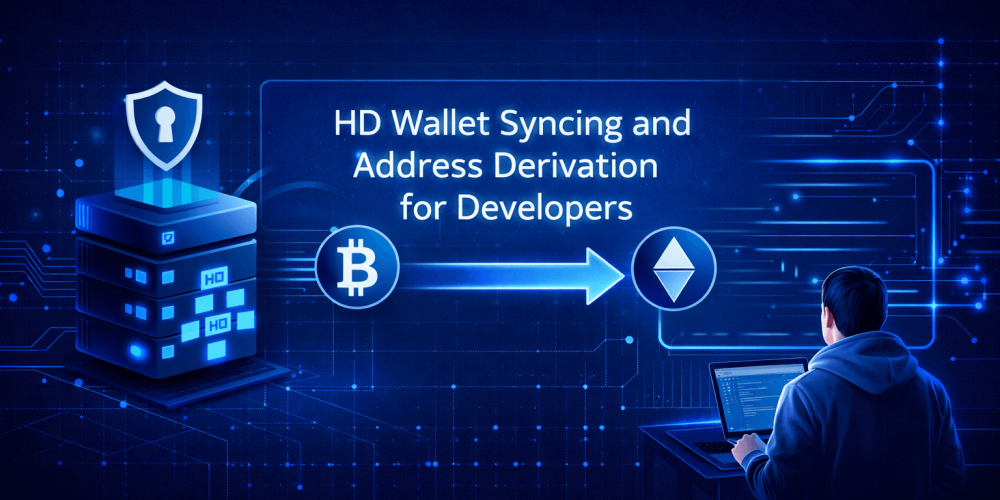
Hierarchical Deterministic (HD) wallets are a widely used approach for generating and managing cryptocurrency addresses at scale. For a quick refresher, an HD wallet is a deterministic wallet where keys are derived from a single seed, rather than being generated as unrelated random keys that must each be backed up separately.
However, for most real-world products, the bigger challenge is not creating an HD wallet - it’s managing it in production. HD wallet management is the operational layer that helps you keep wallet data synchronized, track activity across derived addresses, and build transaction workflows in a way that is scalable and reliable.
This is exactly what Crypto APIs’ HD Wallet Management endpoints are designed to support.
A cryptocurrency wallet does not store coins. Instead, it stores cryptographic keys that are used to prepare, sign, and broadcast transactions.
Wallets can be divided into two broad categories:
HD wallets generate a hierarchy of keys in a tree-like structure, making it possible to derive many keys and addresses from a single source. The original HD wallet structure is connected to BIP-32 (2012), which introduced hierarchical key derivation and made HD wallets possible.
In an HD wallet model, the main components are:
Public addresses can be generated from an xPub, which is why it must be handled carefully.
The Medium article also highlights BIP-44 as an example of how HD wallets can be structured into a hierarchy that supports:
This structure is powerful, but it also introduces a major operational challenge: the more addresses that can be derived, the harder it becomes to keep the wallet fully synchronized.
An extended public key (xPub) can correspond to billions of derived addresses. While this makes HD wallets highly scalable, it also creates a technical challenge for any business that needs to monitor deposits, withdrawals, balances, and transaction history.
The core problem described in the source material is the need to synchronize:
This becomes especially important for platforms that operate at scale. For example, if a crypto exchange has millions of users, it may need to manage millions of addresses. In a non-deterministic wallet model, that implies storing and protecting huge numbers of private keys, which creates both operational overhead and security risk.
HD wallets solve part of the problem by allowing users to share only their xPub for monitoring purposes, while the wallet system can still track activity across derived addresses.
But to make that practical, you need a way to synchronize wallet data continuously and query it efficiently.
Crypto APIs provides HD Wallet Management endpoints built around a clear operational flow: sync the extended public key first, then query wallet data and build transaction workflows using synced addresses.
This approach is designed for cases where retrieving all wallet information directly from the blockchain is too expensive or time-consuming, especially when HD wallets may contain large numbers of addresses and transactions.
Crypto APIs supports syncing an HD wallet by submitting an extended public key such as xPub, yPub, or zPub. After the initial sync, Crypto APIs provides available wallet information related to that extended public key and continues updating the synced wallet with new data.
This sync step is positioned as a prerequisite for retrieving wallet details and transaction information.
Crypto APIs also provides an endpoint for syncing a brand new HD wallet in a way that prepares it for future derivation.
This endpoint is specifically described as:
It is intended to register the wallet so it is ready for subsequent operations.
Once an extended public key is synced, Crypto APIs provides endpoints that derive and synchronize new addresses, ensuring that the system can track activity as the wallet expands.
Crypto APIs can derive up to 100 receiving addresses, starting from the last index the system has data for. If there is no data, it starts from index 0.
These derived receiving addresses are then:
Similarly, Crypto APIs can derive 100 change addresses, starting from the last index with available data. If there is no data, it starts from index 0.
These change addresses are then:
After synchronization, Crypto APIs provides endpoints that allow applications to retrieve key wallet views without repeatedly performing heavy blockchain queries.
This endpoint returns all addresses that have been synced for a specific extended public key, including both historical and newly derived addresses.
This endpoint lists the transactions associated with the HD wallet.
This endpoint lists the unspent transaction outputs (UTXOs) for an already synced HD wallet.
Crypto APIs provides an endpoint that returns supported asset details for a predefined extended public key, including:
Crypto APIs also provides an endpoint described as a way to retrieve the most important wallet data without requiring many calculations. The key point is that once a wallet is synced and continuously updated, these wallet details can be calculated in advance.
Crypto APIs includes transaction endpoints designed to support production workflows where signing is performed locally.
Crypto APIs provides an endpoint that prepares a transaction for signing from all addresses synced with Crypto APIs for the specific xPub.
The preparation is based on:
A critical constraint is explicitly stated:
The source material also gives examples of UTXO-based protocols such as Bitcoin and Litecoin.
Crypto APIs also provides an endpoint that prepares an account-based transaction for signing from a synced with Crypto APIs address from the specific xPub.
The Medium article references account-based protocols such as Ethereum and BSC.
Crypto APIs provides an endpoint to broadcast a locally signed transaction. This is described as an alternative to broadcasting through your own node.
The flow is clearly defined:
The source material highlights several areas where HD wallet management capabilities are useful for crypto and blockchain products, including:
For any system that needs to work with extended public keys, derived addresses, and transaction workflows across multiple blockchain protocols, HD wallet management becomes a critical layer for reliability and scalability.
Crypto APIs’ HD Wallet Management endpoints provide a structured way to sync wallet data, derive addresses, retrieve wallet information, and support transaction preparation and broadcasting - without requiring teams to build the full indexing and monitoring infrastructure themselves.
Networks Supported
Avg Processing Time
Enterprise-ready
of Big Data




 Copy link