



Infrastructure optimized for growth

35+
Networks Supported

25ms
Avg Processing Time

25,000+ rq/s
Enterprise-ready

100+ TB
of Big Data

 Sign in

Access to full transaction data on all transactions & addresses

Retrieve blockchain data, balances, and transactions

Detailed blockchain history and transaction data for any address.

Full smart contracts metadata, including token symbols & token names

Access to full transaction data on all transactions & addresses

Get live crypto prices, exchange rates, supply and token contracts across protocols via one REST API.

Real-time notifications for events on top blockchains. Response under 100ms.

AML address screening across 35+ networks

Sync and manage HD wallets, keys and addresses

Local signing for EVM, UTXO, Tron, XRP, Kaspa and Solana

Precise blockchain transaction fee estimates based on transaction priority

Broadcast and verify transactions with real-time monitoring

Prepare EVM transactions, including token transfers

Test EVM transactions, optimize gas fees and identify security flaws

Pay for HTTP APIs, or charge for your own, in USDC stablecoin over the open x402 protocol — non-custodial, on-chain settlement.

MCP servers, CLI and skills for AI agents

Dedicated nodes infrastructure for leading blockchains using JSON-RPC

Address validation, encoding & cryptographic tasks optimizations

Shared node infrastructure for top blockchains using JSON-RPC.

Jan 14, 2026 • 5 min

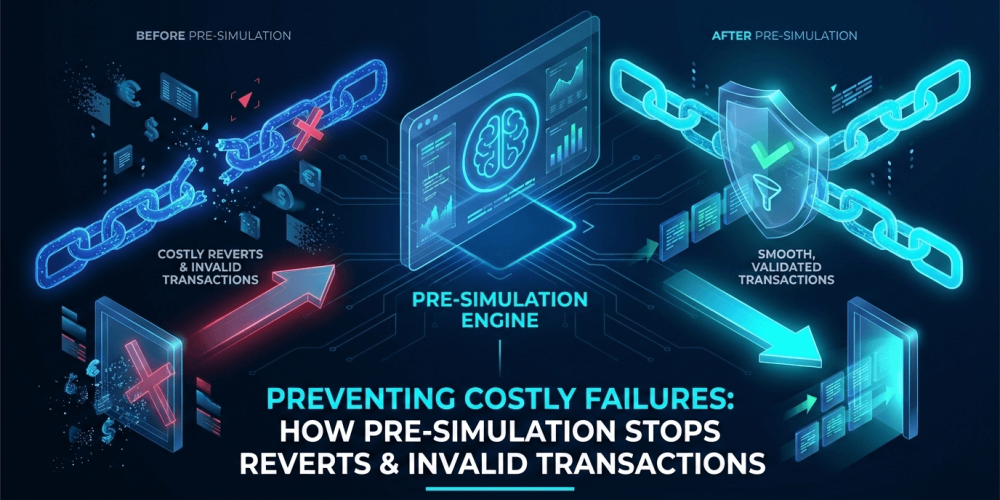
Blockchain transactions are irreversible, publicly visible, and often expensive to execute. For Web3 engineering teams and CTOs, failed transactions are more than a developer inconvenience - they represent direct financial waste, operational inefficiency, and reputational risk. In production environments, repeated transaction failures can quickly translate into customer churn, increased support volume, and degraded trust in the reliability of the product.
This is where pre-simulation becomes a critical part of modern blockchain infrastructure. A transaction simulator enables teams to test and validate a transaction before broadcasting it to a live network, reducing the likelihood of costly execution failures and improving the predictability of on-chain operations.
This article explains how transaction failures occur, how simulation prevents them, and why infrastructure providers that offer transaction simulator error detection capabilities deliver a significant advantage over basic RPC-only setups.
Even well-tested applications experience transaction failures once deployed to real networks. The main reasons include:
A smart contract may reject a transaction due to unmet conditions. This often happens because of validation checks such as insufficient token balance, missing approvals, invalid parameters, or access control restrictions.
From a business perspective, revert transactions create a poor user experience and add cost because gas is still consumed even though the transaction does not succeed.
Gas estimation can be unreliable in complex contract interactions, especially when contract state changes frequently. If a transaction runs out of gas mid-execution, it fails, consuming the allocated gas and forcing the user or application to retry.
Incorrect nonce handling, invalid transaction structure, or incorrect calldata formatting can lead to failures before execution completes. These issues are common in high-throughput environments such as exchanges, custodians, and enterprise transaction processing systems.
Pre-simulation (also referred to as pre-execution) is the process of running a transaction in a simulated environment that mirrors real network conditions, without submitting it to the blockchain.
The goal is straightforward: predict the outcome before spending money on gas.
A strong simulation layer helps teams:
For organizations operating at scale, simulation is not simply a developer convenience - it is a form of transaction risk management.
Crypto APIs provides a Blockchain Transaction Simulator designed to help teams validate transactions before they are broadcast to the network.
At the moment, Ethereum is the only supported blockchain for transaction simulation.
This is important for accuracy and operational planning: the simulator should be treated as an Ethereum-focused solution today, suitable for teams building and scaling Ethereum-based applications and infrastructure.
Crypto APIs is planning to expand support to EVM protocols over time. For teams building multi-chain roadmaps, this is strategically relevant because EVM transaction simulation is a consistent requirement across many ecosystems.
The most valuable outcome of simulation is reducing the number of failures that reach production.
When a transaction would revert due to contract conditions, simulation enables teams to detect this before the transaction is sent. Instead of discovering failure after paying gas, developers can:
This directly supports the goal to avoid revert transactions and protect end users from unpredictable failures.
Simulation helps teams validate whether a transaction is likely to fail due to gas constraints. In high-value workflows (swaps, treasury operations, contract upgrades), a failed transaction can have significant downstream consequences.
By simulating execution first, teams can make more informed decisions about:
Simulation also supports faster troubleshooting. Rather than running repeated live transactions to reproduce an error, engineering teams can simulate execution and use the output to isolate the failure condition.
For enterprise teams, this reduces incident resolution time and improves overall operational reliability.
Below are real-world categories of failure that pre-simulation can reduce:
In each case, simulation enables teams to pre-execute transactions and identify failure conditions before users incur costs.
Many teams start with standard RPC providers because they are necessary for blockchain connectivity. However, RPC endpoints alone typically do not provide a full prevention layer for transaction failure.
With RPC-only infrastructure:
In contrast, transaction simulation adds a proactive layer of intelligence. Providers that offer simulation capabilities help engineering teams reduce failed transactions, protect user experience, and increase confidence in production releases.
For CTOs and platform owners, this difference is material: simulation supports predictable execution, while basic RPC access supports connectivity only.
From an enterprise viewpoint, simulation contributes directly to:
For teams building on Ethereum today and planning broader EVM transaction simulation needs tomorrow, investing in simulation early creates long-term leverage.
Failed blockchain transactions are expensive, visible, and disruptive. The most effective strategy is not better post-mortems - it is prevention.
A transaction simulator provides the ability to validate transactions before broadcasting them, helping teams:
Crypto APIs’ Blockchain Transaction Simulator currently supports Ethereum, with planned expansion into EVM protocols. For teams operating in production environments, pre-simulation is a practical and strategic tool to reduce risk, improve execution reliability, and deliver enterprise-grade Web3 infrastructure.
Networks Supported
Avg Processing Time
Enterprise-ready
of Big Data



 Copy link