



Infrastructure optimized for growth

35+
Networks Supported

25ms
Avg Processing Time

25,000+ rq/s
Enterprise-ready

100+ TB
of Big Data

 Sign in

Access to full transaction data on all transactions & addresses

Retrieve blockchain data, balances, and transactions

Detailed blockchain history and transaction data for any address.

Full smart contracts metadata, including token symbols & token names

Access to full transaction data on all transactions & addresses

Get live crypto prices, exchange rates, supply and token contracts across protocols via one REST API.

Real-time notifications for events on top blockchains. Response under 100ms.

AML address screening across 35+ networks

Sync and manage HD wallets, keys and addresses

Local signing for EVM, UTXO, Tron, XRP, Kaspa and Solana

Precise blockchain transaction fee estimates based on transaction priority

Broadcast and verify transactions with real-time monitoring

Prepare EVM transactions, including token transfers

Test EVM transactions, optimize gas fees and identify security flaws

Pay for HTTP APIs, or charge for your own, in USDC stablecoin over the open x402 protocol — non-custodial, on-chain settlement.

MCP servers, CLI and skills for AI agents

Dedicated nodes infrastructure for leading blockchains using JSON-RPC

Address validation, encoding & cryptographic tasks optimizations

Shared node infrastructure for top blockchains using JSON-RPC.

Jan 8, 2026 • 5 min

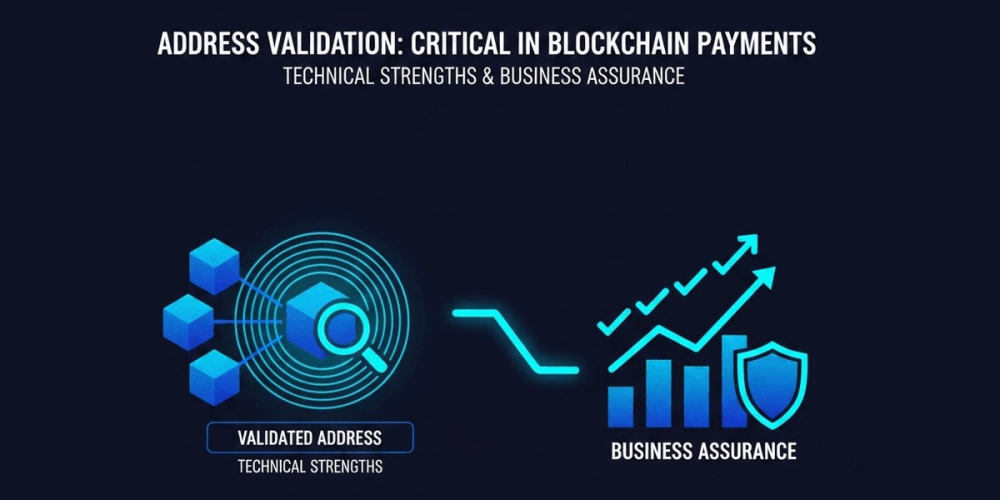
In modern blockchain payments, reliability begins before a transaction is ever signed or broadcast. One of the most critical but often underestimated components of payment infrastructure is address validation, the process of verifying that a wallet address is correctly formatted and compatible with the intended blockchain network.
For developers evaluating integrations, product managers defining payment features, and operations leaders accountable for transaction accuracy, wallet address validation is not a convenience. It is a foundational control that prevents failed transactions, reduces operational overhead, and supports compliance workflows. This article explains why address validation is essential, how it delivers both technical and business value, and how Crypto APIs’ Blockchain Utils provides a practical, multi-chain solution without forcing teams to build and maintain validation logic themselves.
Address validation checks whether a submitted wallet address conforms to the format and rules of a specific blockchain network. Every blockchain has its own addressing scheme. Bitcoin uses Base58 or Bech32 encodings, Ethereum uses hexadecimal addresses with optional checksum encoding, and other networks introduce additional variations.
When a payment system does not validate addresses before processing, several risks emerge:
Address validation acts as a first-line control in transaction verification, ensuring that only syntactically valid addresses for a given network move forward in the payment pipeline.
Crypto APIs includes address validation as part of its Blockchain Utils product suite. These utilities provide standardized APIs for validating blockchain-related inputs so that teams can avoid implementing network-specific rules independently.
On UTXO-based blockchains such as Bitcoin and similar networks, address validation can be fully deterministic. These blockchains rely on strict address formats, version bytes, and checksum rules.
Crypto APIs’ Blockchain Utils exposes address validation endpoints specifically for UTXO-based blockchains. These endpoints confirm whether a given address is structurally valid for the selected blockchain and network type, for example mainnet or testnet.
This is important for developers building payment systems on UTXO networks because:
By integrating UTXO address validation at the API level, development teams eliminate a major source of transaction failure without writing or maintaining protocol-specific validation logic.
Enterprises rarely operate on a single blockchain. Payment platforms increasingly support multiple networks to accommodate different assets, customers, and use cases. This creates technical complexity:
Crypto APIs’ Blockchain Utils addresses this challenge through unified endpoints for multi-chain validation. Developers submit the blockchain identifier, network, and address, and the API performs the appropriate validation for that environment.
For UTXO-based blockchains, this includes deterministic structural validation. For other networks, validation ensures the address format matches the expected standards for that chain. This architecture allows engineering teams to maintain a single integration path while supporting multiple blockchains, significantly reducing development and maintenance effort.
From a business operations perspective, invalid addresses are a recurring source of inefficiency. When an incorrect address is submitted:
By embedding address validation directly into the transaction workflow, payment systems can reject invalid inputs at the earliest possible stage. This reduces the volume of failed transactions and prevents avoidable support tickets.
For high-volume payment processors, even a small percentage of prevented failures can translate into meaningful cost savings and improved operational throughput.
While address validation is not a substitute for AML or sanctions screening, it plays a critical role in blockchain compliance frameworks. Accurate transaction execution is a baseline requirement for auditable financial systems.
By ensuring that transaction destinations are structurally valid for the intended blockchain, organizations:
This is particularly important in regulated environments where operational errors can have compliance, financial, and reputational consequences.
Consider a crypto payment processor that enables merchants to accept digital asset payments across multiple blockchains. Customers submit wallet addresses during checkout for refunds, payouts, or direct payments.
If the processor does not validate addresses before execution:
By integrating address validation into the payment workflow:
The business outcomes are concrete:
This approach allows the processor to scale across multiple blockchains without maintaining custom validation logic for each network.
In blockchain payment systems, correctness is not optional. Address validation is one of the most fundamental safeguards against failed transactions, lost funds, and operational inefficiency.
Crypto APIs’ Blockchain Utils provides a practical, developer-friendly approach to multi-chain validation, including deterministic address validation for UTXO-based blockchains through unified endpoints. By adopting this infrastructure layer, organizations avoid the complexity of maintaining protocol-specific validation logic while gaining a reliable mechanism for transaction verification.
For teams building or scaling blockchain payment solutions, address validation should be treated as a core component of the stack, not an afterthought. It protects funds, streamlines operations, and reinforces the trust that payment systems depend on.
Networks Supported
Avg Processing Time
Enterprise-ready
of Big Data





 Copy link