



Infrastructure optimized for growth

35+
Networks Supported

25ms
Avg Processing Time

25,000+ rq/s
Enterprise-ready

100+ TB
of Big Data

 Sign in

Access to full transaction data on all transactions & addresses

Retrieve blockchain data, balances, and transactions

Detailed blockchain history and transaction data for any address.

Full smart contracts metadata, including token symbols & token names

Access to full transaction data on all transactions & addresses

Get live crypto prices, exchange rates, supply and token contracts across protocols via one REST API.

Real-time notifications for events on top blockchains. Response under 100ms.

AML address screening across 35+ networks

Sync and manage HD wallets, keys and addresses

Local signing for EVM, UTXO, Tron, XRP, Kaspa and Solana

Precise blockchain transaction fee estimates based on transaction priority

Broadcast and verify transactions with real-time monitoring

Prepare EVM transactions, including token transfers

Test EVM transactions, optimize gas fees and identify security flaws

Pay for HTTP APIs, or charge for your own, in USDC stablecoin over the open x402 protocol — non-custodial, on-chain settlement.

MCP servers, CLI and skills for AI agents

Dedicated nodes infrastructure for leading blockchains using JSON-RPC

Address validation, encoding & cryptographic tasks optimizations

Shared node infrastructure for top blockchains using JSON-RPC.

Dec 18, 2025 • 4 min

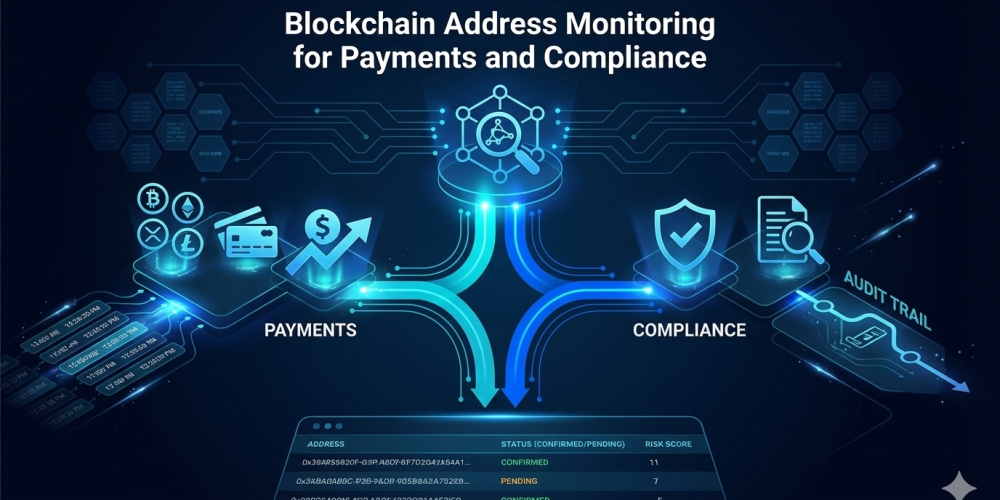
Blockchain address monitoring sits at the core of every serious crypto payment or compliance system. Whether you operate a payment gateway, an exchange, a wallet, or a fintech product that accepts on-chain deposits, you need reliable visibility into what happens at specific blockchain addresses. Missed transactions, delayed confirmations, or incorrect credits are not edge cases, they are operational failures.
Most articles on this topic focus almost entirely on Ethereum and often stop at basic event listening. In practice, real-world systems must handle very different blockchain models, including UTXO-based networks like Bitcoin and Litecoin and tag-based routing on XRP Ledger. This is where a multi-chain, API-first approach becomes essential.
Address monitoring is the process of tracking transactions related to a specific blockchain address and reacting to those events in a controlled and auditable way. In payment and compliance environments, monitoring typically covers:
This is not only about knowing that a transaction happened. It is about knowing when it happened, how reliable it is, and whether it meets your internal crediting and risk rules.
Many guides assume all blockchains behave like Ethereum. This assumption breaks down quickly when you support multiple networks.
Bitcoin and Litecoin do not maintain balances in the same way account-based blockchains do. Funds are represented by unspent transaction outputs rather than a single balance value. For monitoring, this means:
Monitoring on UTXO chains requires more than simply watching for a balance change. A system must understand transaction flows and confirmations to avoid incorrect credits.
On XRP Ledger, a single address may serve many users, with destination tags used to identify the recipient. Ignoring tags leads to misrouted deposits and manual recovery work. Address monitoring on XRP must always treat the address and tag combination as the true destination.
These differences are the reason Ethereum-only tooling often becomes fragile when extended to other chains.
For payment providers, the primary goal is simple: credit users correctly and on time.
The complexity lies in steps two and three. Transactions may appear unconfirmed, may be replaced, or may take longer than expected to reach a safe state. Reliable monitoring ensures your system reacts only when conditions are met.
Constantly querying the blockchain to check whether something has changed is inefficient and slow at scale. Event-based monitoring allows your system to receive notifications when relevant activity occurs. This approach reduces infrastructure load and ensures deposits are detected promptly, even during high network activity.
Compliance teams look at blockchain data differently from payment systems. Their focus is on traceability, consistency, and defensibility.
Address monitoring supports compliance by:
A reliable monitoring setup ensures that operational data and compliance records are derived from the same source of truth, reducing inconsistencies between teams.
In practice, most systems combine two approaches:
Real-time notifications are ideal for triggering business logic, such as crediting a deposit. Address-level queries are useful for reconciliation, recovery, and sanity checks. Together, they provide both speed and reliability without overcomplicating the architecture.
Supporting Bitcoin, Ethereum, XRP Ledger, and Litecoin often leads to fragmented logic and chain-specific code paths. A unified API approach reduces this complexity by offering:
For developer teams, this means less custom logic per blockchain and fewer production issues caused by network-specific edge cases.
To build a monitoring system that scales across blockchains, developer teams should focus on:
These practices reduce operational risk and make systems easier to maintain as transaction volume grows.
How many confirmations should I wait before crediting a deposit?
This depends on the blockchain and your risk tolerance. Bitcoin and Litecoin typically require more confirmations than Ethereum or XRP Ledger.
Can I monitor the same address across multiple blockchains?
Yes, as long as the monitoring system supports each blockchain model correctly and keeps data isolated per network.
Is address monitoring enough for compliance?
Address monitoring is a foundation. It provides the data needed for audits and investigations, but it should be combined with internal policies and review processes.
Blockchain address monitoring is not a feature you add at the end of a product. It is a core capability that affects payments, user trust, and compliance readiness. Teams that rely on Ethereum-only patterns often struggle when they expand to Bitcoin, Litecoin, or XRP Ledger.
By adopting a multi-chain, API-driven approach to address monitoring, developer teams can build systems that are faster to scale, easier to audit, and far more resilient in production.
Networks Supported
Avg Processing Time
Enterprise-ready
of Big Data



 Copy link