



Infrastructure optimized for growth

35+
Networks Supported

25ms
Avg Processing Time

25,000+ rq/s
Enterprise-ready

100+ TB
of Big Data

 Sign in

Access to full transaction data on all transactions & addresses

Retrieve blockchain data, balances, and transactions

Detailed blockchain history and transaction data for any address.

Full smart contracts metadata, including token symbols & token names

Access to full transaction data on all transactions & addresses

Get live crypto prices, exchange rates, supply and token contracts across protocols via one REST API.

Real-time notifications for events on top blockchains. Response under 100ms.

AML address screening across 20+ blockchains

Sync and manage HD wallets, keys and addresses

Local signing for EVM, UTXO, Tron, XRP, Kaspa and Solana

Precise blockchain transaction fee estimates based on transaction priority

Broadcast and verify transactions with real-time monitoring

Prepare EVM transactions, including token transfers

Test EVM transactions, optimize gas fees and identify security flaws

Pay for HTTP APIs, or charge for your own, in USDC stablecoin over the open x402 protocol — non-custodial, on-chain settlement.

MCP servers, CLI and skills for AI agents

Dedicated nodes infrastructure for leading blockchains using JSON-RPC

Address validation, encoding & cryptographic tasks optimizations

Shared node infrastructure for top blockchains using JSON-RPC.

Mar 25, 2026 • 5 min


The hidden cost behind EVM fragmentation, DeFi data gaps, and Web3 gaming failures in 2026
The developer ecosystem is sending a clear signal right now. Three of the most-watched GitHub repositories trending in 2026 — Berachain's Polaris EVM framework, Chainlink's defi-minimal, and MoralisWeb3's unity-web3-game-kit — have almost nothing to do with each other on the surface. One is a modular consensus layer. One strips DeFi protocols to their minimum viable form. One connects game engines to blockchain wallets.
But they all point to the same underlying problem: building on blockchain is no longer hard. Managing the infrastructure around it is.
This post breaks down what each of these trends actually reveals about where engineering time gets wasted — and what a purpose-built blockchain data API changes about that equation.
Berachain's Polaris (1,000+ GitHub stars and climbing) proves that modular EVM architecture has crossed from theoretical to production-ready. Polaris decouples the Ethereum Virtual Machine from its consensus layer, allowing it to plug into alternative engines including the Cosmos SDK. The implication is simple but compounding: the number of EVM-compatible chains is not slowing down. It is accelerating.
For product teams, this creates a concrete infrastructure problem that compounds with every chain you need to support.
Most teams start with hardcoded chain-specific logic — custom RPC calls, manual webhook setups, bespoke indexing pipelines. It works for one chain. It starts to fracture at three. By the time you are supporting five EVM networks, you are running five separate maintenance surfaces for what should be commodity infrastructure.
The real cost is not the initial build. It is the ongoing drag. Teams that do not abstract their blockchain data layer early consistently spend 40–60% of backend engineering cycles on infrastructure maintenance rather than product development. That is not a technical problem. It is a competitive one.
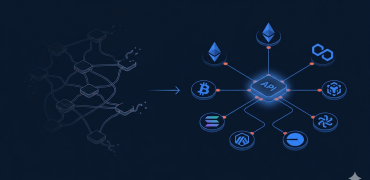
What changes with a unified blockchain API: A single, consistent API surface across 60+ blockchain networks means adding chain support takes hours, not sprints. Whether you are querying confirmed transactions, streaming mempool activity, or broadcasting signed transactions, the interface stays the same regardless of which EVM chain sits underneath. You evaluate Polaris-based chains with the same integration you already have in production.
The trending popularity of Chainlink's defi-minimal repo tells a story that most DeFi post-mortems miss. Smart contract logic for lending protocols, AMMs, and yield products has become increasingly commoditized. Teams are not reaching for stripped-down primitive references because they cannot write the contracts — they are reaching for them because they want to ship faster and focus elsewhere.
The elsewhere is what breaks DeFi products in production.
What actually causes 3am incidents is everything around the contract: detecting on-chain events reliably under load, monitoring transaction confirmation latency across blocks, handling mempool-level data for MEV-sensitive operations, and syncing historical state fast enough for analytics dashboards to stay useful. None of this is glamorous. All of it is critical.
The simultaneous rise of damn-vulnerable-defi-foundry (510+ stars) reflects a parallel maturity shift — serious DeFi teams are running adversarial testing as standard practice. But here is what most security reviews overlook: the attack vectors that exploit real protocols in the wild — flash loan attacks, oracle manipulation, sandwich attacks — require real-time mempool visibility to detect and respond to. If your infrastructure cannot stream unconfirmed transaction data with sub-second latency, your monitoring layer is blind during exactly the window that matters most.
What changes with production-grade blockchain APIs: Purpose-built endpoints for DeFi operational needs — mempool transaction streaming, confirmed event webhooks, token balance tracking, and historical on-chain data queries — without managing a single node. For teams running Foundry-based testing workflows, your staging and production environments share the same reliable data layer. The gap between what you tested and what hits mainnet gets dramatically smaller.
Web3 gaming is past the proof-of-concept phase. Studios and indie teams are shipping on-chain game mechanics, NFT asset ownership, and token-gated content at real scale. The unity-web3-game-kit from MoralisWeb3 (549+ stars) reflects genuine developer demand — wallet connection and basic chain interaction are increasingly solved problems.
What is not solved is what happens when those games hit production at player scale.
Games are uniquely unforgiving infrastructure consumers. A 500ms delay in a financial dashboard is inconvenient. The same delay in verifying NFT ownership before a player enters a match is a gameplay-breaking UX failure. Public RPC nodes rate-limit aggressively under load. Self-hosted nodes require DevOps resources most game studios cannot justify. The result is asset verification failures, in-game event triggers that fire late or not at all, and player experiences that erode trust faster than any smart contract bug.
Web3 game backends require a different infrastructure profile than DeFi protocols or exchange integrations: high-throughput webhook-based event triggers rather than polling loops, HD wallet APIs capable of generating and managing thousands of player wallet addresses without custom key management, and multi-chain support without separate integration pipelines for every L1 and L2 your players might be coming from.
What changes with blockchain infrastructure built for gaming: Real-time webhook notifications for on-chain events at production scale — NFT transfers, token movements, wallet activity — without rate-limiting risk. The HD Wallet API handles player wallet management at scale. The same integration supports 60+ networks, so players are not chain-locked and studios are not building parallel pipelines.
Three different use cases. Three different developer communities. The same infrastructure bottleneck.
Modular EVM chains multiply the number of networks you need to support. DeFi protocols break not because of bad contracts but because of slow or blind data layers. Web3 games fail in production not because of smart contract logic but because public nodes cannot handle real player load.
The answer in each case is not a smarter contract, a more skilled DevOps team, or a longer infrastructure sprint. It is removing the infrastructure problem from the equation entirely with a blockchain data API layer that handles normalization, reliability, and multi-chain support so your engineering team can focus on the product.
CryptoAPIs.io supports 60+ blockchain networks — EVM and non-EVM — under a single, consistent API surface. From the Blockchain Data API and Node-as-a-Service to the HD Wallet API and real-time event webhooks, the full infrastructure stack is available without managing a single node.
Explore the full API suite at CryptoAPIs.io — free tier available, full documentation included
Networks Supported
Avg Processing Time
Enterprise-ready
of Big Data


 Copy link