



Infrastructure optimized for growth

35+
Networks Supported

25ms
Avg Processing Time

25,000+ rq/s
Enterprise-ready

100+ TB
of Big Data

 Sign in

Access to full transaction data on all transactions & addresses

Retrieve blockchain data, balances, and transactions

Detailed blockchain history and transaction data for any address.

Full smart contracts metadata, including token symbols & token names

Access to full transaction data on all transactions & addresses

Get live crypto prices, exchange rates, supply and token contracts across protocols via one REST API.

Real-time notifications for events on top blockchains. Response under 100ms.

AML address screening across 35+ networks

Sync and manage HD wallets, keys and addresses

Local signing for EVM, UTXO, Tron, XRP, Kaspa and Solana

Precise blockchain transaction fee estimates based on transaction priority

Broadcast and verify transactions with real-time monitoring

Prepare EVM transactions, including token transfers

Test EVM transactions, optimize gas fees and identify security flaws

Pay for HTTP APIs, or charge for your own, in USDC stablecoin over the open x402 protocol — non-custodial, on-chain settlement.

MCP servers, CLI and skills for AI agents

Dedicated nodes infrastructure for leading blockchains using JSON-RPC

Address validation, encoding & cryptographic tasks optimizations

Shared node infrastructure for top blockchains using JSON-RPC.

Jan 29, 2026 • 3 min

Building Web3 products means living in a world where blockchain data changes constantly, new blocks, new transactions, new smart contract calls, and new token transfers every second. If your application reacts late (or misses an event entirely), users feel it immediately: delayed balance updates, missed trading signals, slow confirmations, or broken workflows.
That’s why blockchain event monitoring has become a core infrastructure layer for modern crypto applications.
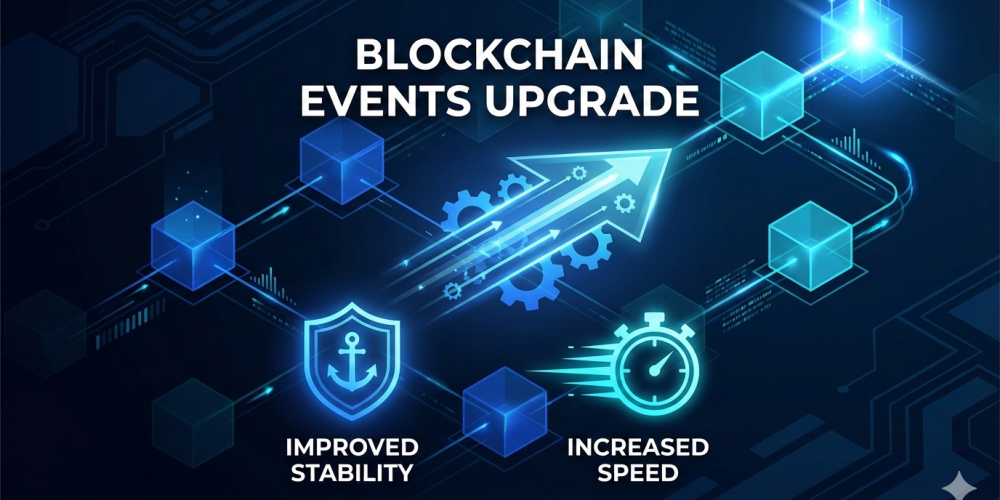
Crypto APIs’ Blockchain Events service has recently undergone major performance and stability upgrades, delivering near real-time event delivery with no delay and significantly improved webhook reliability across all supported protocols, including both mainnets and testnets.
If you’re looking for a production-ready solution for real-time blockchain events, webhook-based blockchain monitoring, and multi-chain event tracking, this update is designed for you.
A blockchain event is any meaningful on-chain activity your application might care about, such as a transaction being confirmed, a wallet receiving funds, a token transfer, a smart contract emitting logs/events, or a new block being produced.
From a developer perspective, blockchain events are the foundation of event-driven architecture in Web3.
Instead of constantly polling nodes or running custom indexers, teams often use a blockchain events API that can push updates to their system automatically via webhooks, so apps can react instantly.
In many Web3 use cases, even a few seconds of delay can cause:
That’s why the market demand has shifted from “event delivery” to real-time blockchain event streaming with stable delivery guarantees.
Many teams start with a basic approach:
But in production, these approaches often hit hard limitations, especially when you need to scale across multiple networks.
Latency spikes, unreliable delivery, inconsistent testnet behavior, and the operational overhead of maintaining different integrations across different protocols can quickly slow down product development.
Crypto APIs delivered significant optimization work across the Blockchain Events service, with improvements focused on what matters most for production systems: speed, stability, and real-time consistency.
The biggest upgrade is near real-time event delivery with no delay across all supported protocols and networks.
Whether you're tracking:
You get the same expectation: events are delivered fast, without lag.
This is especially important for systems that rely on immediate reactions, such as alerting pipelines, automated workflows, and responsive user experiences.
If you’ve ever built a webhook-based system, you know reliability matters as much as speed.
Crypto APIs’ Blockchain Events service now provides significantly improved stability, particularly in webhook delivery, across:
This reduces the need for complex retry logic, lowers operational risk, and makes it easier to build event-driven systems that behave consistently under real-world conditions.
Modern applications rarely live on a single chain. You may support Ethereum users today, add Polygon tomorrow, and later expand to Solana, Avalanche, or Layer 2 networks.
Crypto APIs’ Blockchain Events supports 30+ blockchains, but the bigger advantage is this:
Regardless of which protocol you need, Crypto APIs provides a unified API experience.
Instead of building and maintaining separate integrations for every network, your team can rely on:
That means less complexity, faster development, and a cleaner path to supporting new chains without rewriting your infrastructure.
Crypto APIs’ Blockchain Events service is built for teams that need infrastructure that behaves predictably in production.
With the latest improvements, developers get:
Instead of worrying about missing events, delivery failures, or chain-specific edge cases, your team can focus on building product features that matter.
Blockchain events are the heartbeat of Web3 applications, but delivering them reliably is one of the hardest infrastructure challenges teams face.
With Crypto APIs’ latest upgrades, Blockchain Events now provides:
If your team is searching for a reliable blockchain events API, a webhook-based blockchain monitoring solution, or a way to scale multi-chain event tracking without building custom indexers, Crypto APIs Blockchain Events is built for exactly that.
Networks Supported
Avg Processing Time
Enterprise-ready
of Big Data


 Copy link