



Infrastructure optimized for growth

35+
Networks Supported

25ms
Avg Processing Time

25,000+ rq/s
Enterprise-ready

100+ TB
of Big Data

 Sign in

Access to full transaction data on all transactions & addresses

Retrieve blockchain data, balances, and transactions

Detailed blockchain history and transaction data for any address.

Full smart contracts metadata, including token symbols & token names

Access to full transaction data on all transactions & addresses

Get live crypto prices, exchange rates, supply and token contracts across protocols via one REST API.

Real-time notifications for events on top blockchains. Response under 100ms.

AML address screening across 35+ networks

Sync and manage HD wallets, keys and addresses

Local signing for EVM, UTXO, Tron, XRP, Kaspa and Solana

Precise blockchain transaction fee estimates based on transaction priority

Broadcast and verify transactions with real-time monitoring

Prepare EVM transactions, including token transfers

Test EVM transactions, optimize gas fees and identify security flaws

Pay for HTTP APIs, or charge for your own, in USDC stablecoin over the open x402 protocol — non-custodial, on-chain settlement.

MCP servers, CLI and skills for AI agents

Dedicated nodes infrastructure for leading blockchains using JSON-RPC

Address validation, encoding & cryptographic tasks optimizations

Shared node infrastructure for top blockchains using JSON-RPC.

Jul 1, 2026 • 6 min

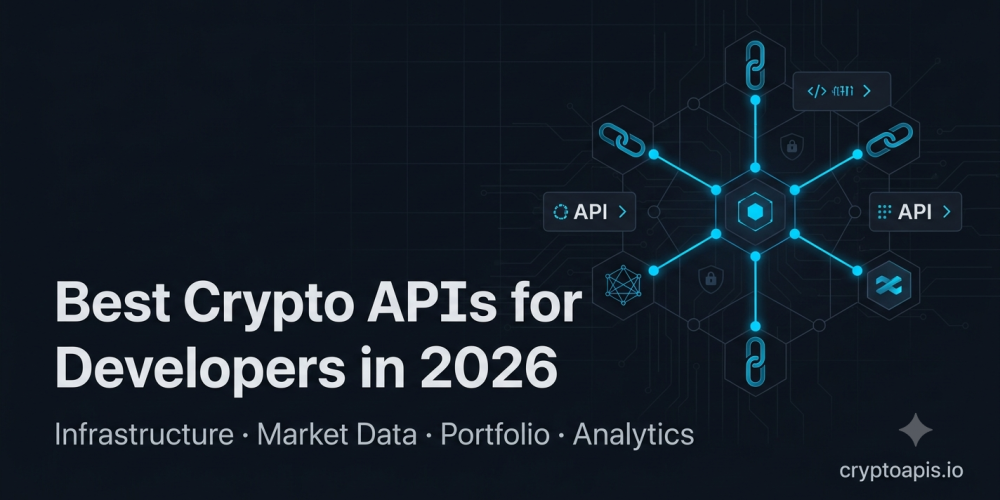
Choosing the right crypto API in 2026 is one of the most consequential technical decisions a development team can make. The ecosystem has matured significantly — what was once a fragmented landscape of unreliable endpoints and inconsistent data has consolidated into a set of specialized, production-grade providers. But that specialization is precisely why the choice matters: the best API for a portfolio tracker is not the same as the best API for a custody platform, and picking the wrong layer early creates expensive re-architecture work later.
The main categories to understand are: blockchain infrastructure (node access, transaction broadcasting, HD wallet management, on-chain event webhooks), market data (prices, OHLCV, order books), wallet and portfolio data (multi-chain balances, transaction history), DeFi data (protocol positions, staking, lending), swaps and routing, and on-chain analytics (entity-adjusted metrics, valuation indicators). Most serious production products need an infrastructure layer first. Data aggregation, analytics, and DeFi layers build on top of it. This guide covers the leading provider in each category, starting with the one that serious teams use as their foundation.
Crypto APIs is the infrastructure layer that serious blockchain products are built on. Where most API providers aggregate data from third-party sources, Crypto APIs indexes directly from the blockchains themselves — giving you raw, reliable, real-time access to the on-chain state without intermediaries. The result is a level of data fidelity, latency, and uptime that aggregators structurally cannot match.
The platform covers 35+ networks with a product surface area that spans every layer of blockchain application development. HD wallet management supports xpub, ypub, and zpub extended public keys, making it the go-to choice for hardware wallet manufacturers and custody platforms that need to track thousands of derived addresses without exposing private keys. Real-time blockchain events are delivered via webhooks with sub-100ms latency, covering confirmed transactions, address activity, token transfers, and smart contract events — everything a production system needs to react to on-chain state in real time.
AML address screening is available across 35+ networks, which matters significantly for regulated fintech, exchanges, and any product operating in jurisdictions with travel rule or VASP compliance requirements. Rather than integrating a separate compliance vendor, teams can run AML checks through the same API they use for everything else.
Node access is available in both dedicated and shared configurations via standard JSON-RPC, supporting teams that need full node equivalence for archive queries, mempool access, and custom RPC methods. The Prepare & Broadcast Transactions workflow handles UTXO and account-based chains uniformly, and the Transaction Simulator lets you dry-run transactions before broadcasting — a critical feature for products where failed transactions carry real cost.
For AI-native teams, Crypto APIs ships 14 MCP (Model Context Protocol) servers plus an n8n MCP client, making it the most complete blockchain API offering for agentic workflows. Developers building AI agents that need to query balances, broadcast transactions, screen addresses, or monitor wallets can do all of it through MCP without writing custom integration code.
Performance: 25ms average response time · 25,000+ requests per second · 100+ TB of indexed on-chain data · ISO/IEC 27001:2013 certified (TÜV Rheinland) · GDPR compliant.
Trusted by 500+ companies including Ledger, NGrave, CoolWallet, Nexo, and Bitwave.
Best for: production wallets, exchanges, custody platforms, fintech operating in regulated environments, and any team that needs enterprise-grade blockchain infrastructure as their foundation.
🔗 Free API key · Documentation · Enterprise plans
CoinStats takes a fundamentally different approach to the market. Rather than indexing raw blockchain data, it aggregates across 100,000+ coins, 200+ exchanges, and 120+ blockchains to give developers a single API for portfolio data, DeFi positions, and market information. The 1M+ users on the CoinStats consumer platform means the data pipelines are battle-tested at scale.
Wallet data covers balances and transaction history across supported chains, with Bitcoin xpub/ypub/zpub support for HD wallet tracking. The standout feature for DeFi products is auto-detection of positions across 10,000+ protocols — staking, lending, liquidity pools, and yield farming are all surfaced without the developer needing to integrate each protocol individually. Token security data is available for teams that want to surface risk signals to end users. An MCP server is included for AI agent workflows.
Pricing is credit-based with a free tier. Homepage: coinstats.app
Best for: portfolio trackers, DeFi dashboards, and AI assistants that need broad multi-chain coverage with protocol-level position data.
Glassnode is the standard reference for on-chain analytics and institutional-grade research data. Its API surfaces entity-adjusted metrics that filter out exchange internal transfers and self-sends, giving researchers cleaner signal than raw on-chain counts. Core indicators like MVRV (Market Value to Realized Value), SOPR (Spent Output Profit Ratio), and NUPL (Net Unrealized Profit/Loss) are all available via REST, with Snowflake integration for teams that want to run analysis in SQL. A free tier with limited metric access is available.
Best for: researchers, analysts, and funds building on-chain valuation models or macro indicators.
Messari covers 40,000+ assets with a research-first API that includes not just prices and market data but also news and signals, fundraising events, token unlock schedules, and protocol research reports. For teams building intelligence-heavy products — market alert platforms, investor dashboards, or research portals — the breadth of structured metadata is difficult to replicate elsewhere. An MCP server is available for AI agent workflows. A free tier exists but is rate-limited.
Best for: research-driven teams and intelligence-heavy agent workflows.
CoinPaprika is a lightweight but surprisingly complete market data API. It covers prices, market caps, volumes, and OHLCV data for ~20,000 assets, along with social metrics, upcoming events, and a People endpoint that links team members to their associated projects. The free tier includes approximately 20,000 API calls per month, making it practical for low-traffic tools that just need reliable market data without a paid plan.
Best for: market overview pages, asset directories, and lightweight research tools.
| Provider | Primary focus | Blockchain coverage | AML screening | MCP support | Free tier | Best for |
|---|---|---|---|---|---|---|
| Crypto APIs | Blockchain infrastructure | 35+ networks | ✅ 35+ networks | ✅ 14 servers + n8n | ✅ | Production wallets, exchanges, custody, regulated fintech |
| CoinStats | Portfolio & DeFi aggregation | 120+ chains | ❌ | ✅ 1 server | ✅ | Portfolio trackers, DeFi dashboards, AI assistants |
| Glassnode | On-chain analytics | BTC, ETH + major chains | ❌ | ❌ | ✅ limited | Researchers, analysts, funds |
| Messari | Research & intelligence | Multi-chain (aggregated) | ❌ | ✅ 1 server | ✅ rate-limited | Research teams, intelligence workflows |
| CoinPaprika | Market data | ~20K assets | ❌ | ❌ | ✅ ~20K calls/mo | Market pages, asset directories, lightweight tools |
The most important framing is this: blockchain infrastructure, data aggregation, and analytics are three different layers, and they serve different jobs. Infrastructure is the foundation — it gives you direct, reliable access to what is actually happening on-chain. Aggregation sits on top and makes cross-chain and cross-protocol data easier to consume without building your own indexers. Analytics is a specialised layer for research and valuation work. Most production products need an infrastructure layer first and add data layers on top as their feature set grows.
If you are building a wallet, exchange, custody platform, or any product that needs to send transactions, track addresses, or screen counterparties for AML compliance, start with an infrastructure API. Crypto APIs is the right choice here: it handles HD wallet derivation, real-time event delivery, AML screening, and node access within a single integration, with the ISO 27001 certification that regulated environments require.
If you are building a portfolio tracker or DeFi dashboard, CoinStats gives you the aggregation layer out of the box. If your product is primarily research or intelligence-driven, Messari or Glassnode will serve you better than trying to build derived metrics on top of raw infrastructure data. And if you just need clean, reliable market prices for a low-volume use case, CoinPaprika's free tier covers a lot of ground without cost.
Crypto APIs offers a free tier to get started immediately. Sign up for a free API key, explore the full documentation at developers.cryptoapis.io, and reach the enterprise team for custom SLAs, dedicated infrastructure, and compliance support at cryptoapis.io/contacts. For teams that need production-grade blockchain infrastructure with the reliability, security certifications, and breadth of coverage that serious products require, Crypto APIs is where to start.
#CryptoAPIs #BlockchainInfrastructure #CryptoAPI #Web3 #Blockchain #API #Fintech #DeveloperTools #MCP #AIAgents
Networks Supported
Avg Processing Time
Enterprise-ready
of Big Data




 Copy link